

What Is an AI Data Center? Compute, Networks, Power and Cooling

Hunter Newby
November 23, 2026
What is an AI data center? It is a facility whose computing, storage, networking, power and cooling support AI workloads such as training or inference. The useful test is whether those systems fit the intended workload together. A supply of GPUs or an announcement about power alone does not establish a complete deployment.
Asking what is an AI data center is therefore a procurement question as well as a definition question. A buyer needs to identify the workload, who operates each component, where users and data are located, and what can actually be delivered under the contract.
- Evaluate a workload-ready system, not a single infrastructure headline.
- Separate communication inside the compute cluster from the path to users.
- Verify present service availability and operating responsibility.
What is an AI data center in operational terms?
IBM's AI data center explanation identifies compute, network, storage, energy and cooling capabilities as parts of the facility. Those categories provide a useful starting checklist. Their required configuration depends on the application rather than a universal AI-ready label.
Start with the job to be performed: training a model, adapting an existing model, serving requests, or supporting a mixture of activities. Document the data involved, service objectives, expected demand pattern and operational constraints. The facility comparison becomes more useful once these requirements are explicit.
Training and inference need different questions
Training changes a model using data and computation. Inference uses a trained model to produce outputs. Different workloads place different demands on accelerators, memory, storage and communications. A general-purpose explanation should not prescribe one equipment size or rack density for every organization.
For an interactive inference service, include the user's experience in the acceptance plan: request handling, model execution, queuing and the external network all deserve attention. A fast connection between accelerators does not, by itself, establish the response time experienced by a distant customer.
The answer to what is an AI data center changes little at the category level, but the purchase specification changes substantially with the workload. Write down the specification before comparing the sales descriptions.
Keep internal and external networks separate
The internal cluster network helps computing components communicate. External connectivity carries traffic to users, data sources, other facilities and cloud services. These are related responsibilities, but they are not interchangeable measurements.
Hunter Newby's physical interconnection framework provides context for the external side: digital services still depend on physical connections between networks. Apply that perspective by asking where a service is actually delivered and how traffic reaches it, without claiming a measured improvement that has not been tested.
Use four evidence gates before an order
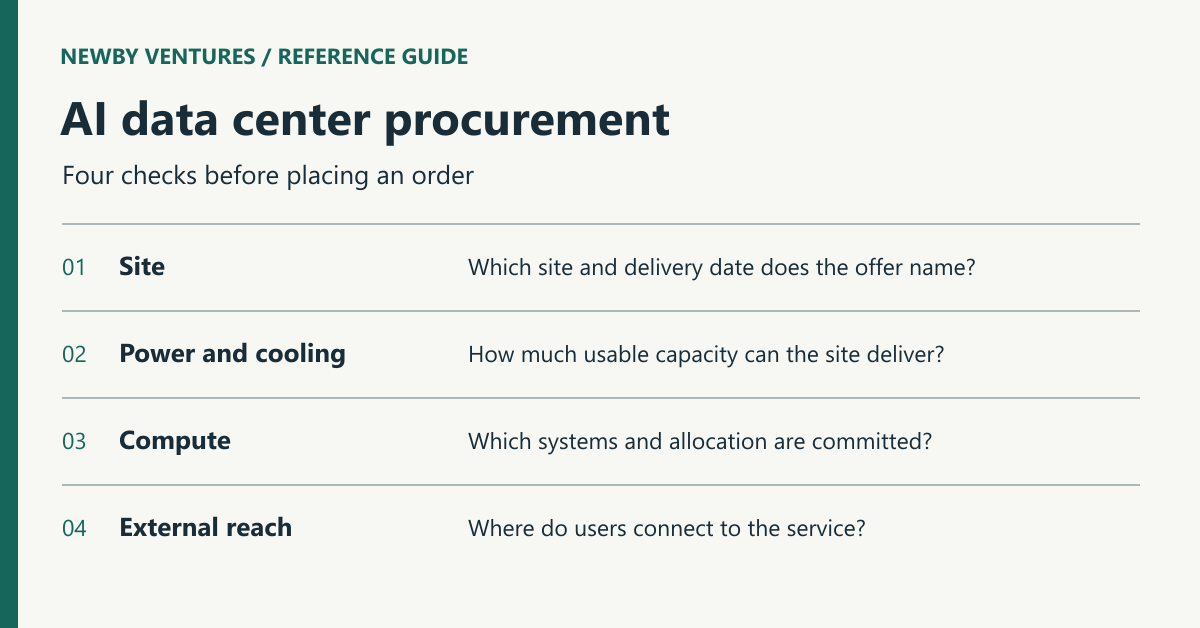
This original worksheet turns what is an AI data center into four checks. The gates are procurement questions, not an engineering design standard. Assign an owner, an evidence date and an acceptance condition to each one.
| Gate | Evidence to establish | Unresolved question |
|---|---|---|
| Site and building | Specific location, installation scope and access arrangements | Which approvals or physical dependencies remain? |
| Power and cooling | Capacity and operating conditions committed to this equipment | Is the capacity available now or dependent on future work? |
| Compute and storage | Hardware/service specification, supporting networks and operator | Who configures, monitors and maintains the system? |
| Reach and service | User/data locations, external paths, support and acceptance plan | What will be measured before the service is accepted? |
Choose a delivery model before comparing prices
An owned facility, customer-owned equipment in colocation and a managed compute service allocate responsibility differently. Cloud services can also supply the required capability without the customer building a new facility. Compare what the buyer receives and operates, not just an apparently similar unit price.
A proposal for powered space is not a proposal for an administered AI application. A managed accelerator service may also exclude parts of the data pipeline or application operation. Ask each vendor to mark included, optional and customer-owned work in the same responsibility table.
When a proposal answers what is an AI data center with a future campus announcement, ask which service can be ordered today. Keep construction plans, financing milestones and currently usable service distinct in the evaluation.
A practical inference example
Imagine an organization comparing two locations for an interactive inference application. One offers a well-specified compute service; the other offers suitable space for equipment the customer would operate. This is an illustrative comparison, not a claim about named providers or measured performance.
The organization should define a representative request, required data access, operating ownership and user locations. It can then compare the complete delivery plans and test conditions. The same word, capacity, may otherwise conceal different hardware, dates and responsibilities.
What is an AI data center worth to that organization? The answer rests on a supported service that meets its requirements. A useful next step is a written acceptance plan shared by the application owner, infrastructure team and provider.
Frequently asked questions
What is an AI data center's defining feature?
It supports the requirements of AI workloads across compute and the infrastructure around it. No single product label proves that the complete workload can run as intended.
Does every AI application require a new facility?
No. Suitable existing cloud services, managed infrastructure or colocation can be options, depending on the workload and ownership model.
Do training and inference have identical requirements?
No. Evaluate their actual compute, data, communication and service requirements rather than using one specification for both.
Does a fast GPU fabric guarantee fast answers for users?
No. Application work, queuing, external connectivity and other parts of the delivery path also affect the observed service.
Does announced power mean capacity is available now?
It does not establish that. Request the committed capacity, delivery date, operating conditions and dependencies for the proposed installation.
Who should approve the technical acceptance conditions?
The responsible application and infrastructure owners should agree them with the supplier and relevant specialists. This educational checklist does not replace site-specific design or testing.
About the Author

Hunter Newby
Founder, Newby Ventures
Entrepreneur, investor, and interconnection pioneer. Co-founded Telx, conceived the carrier-neutral Meet-Me-Room, and led data center development across the U.S. Now investing in network-neutral infrastructure through Newby Ventures.
Read more about Hunter →