


Carrier Hotel vs Colocation: Compare Network Access, Space and Control

Hunter Newby
November 23, 2026
Carrier hotel vs colocation compares a network-dense location with a hosting service. A carrier hotel brings networks into physical proximity; colocation supplies space and supporting infrastructure for customer equipment. The categories overlap. The buying decision depends on the connections, capacity and operating rights that a particular deployment can actually obtain.
A carrier hotel vs colocation decision should begin with the workload and its destinations. An attractive address cannot establish available power, a usable cross-connect or a suitable commercial agreement. A less famous facility may meet the requirement if the needed services are available and the responsibilities are clear.
- Separate the building from the services ordered inside it.
- Confirm the particular networks and connection paths your deployment needs.
- Compare power, cooling, support and access terms independently.
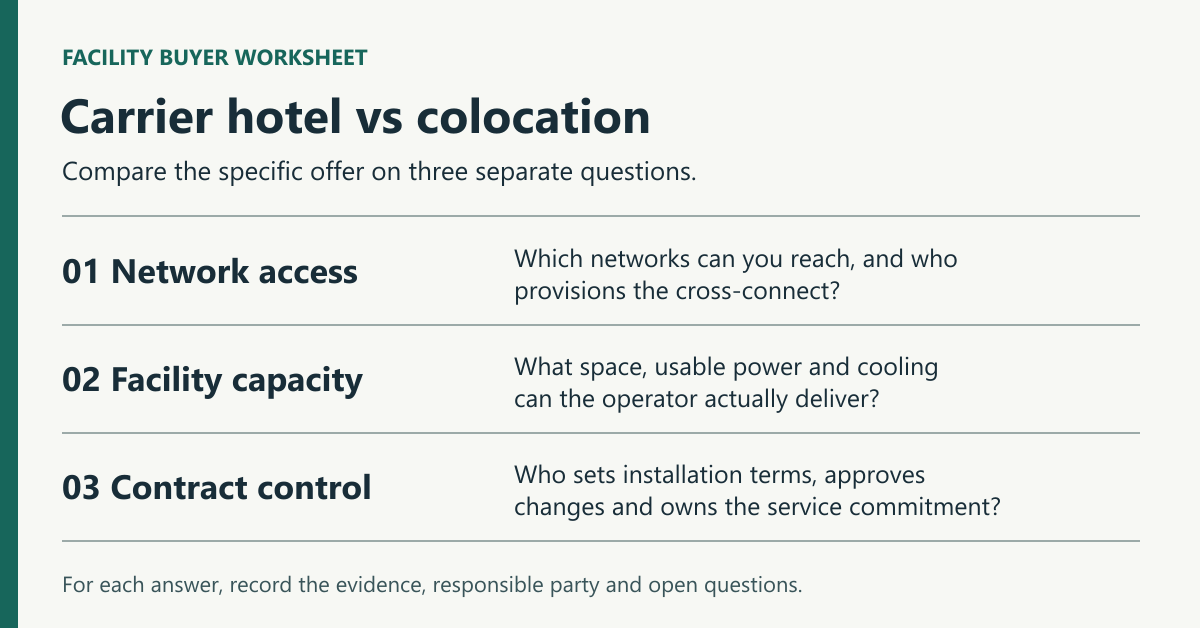
Carrier hotel vs colocation: define the purchase
Colocation is the placement of customer equipment in a provider's facility, with contracted infrastructure and services. A carrier hotel is a location associated with a concentration of telecommunications networks and interconnection activity. Neither label tells you exactly what is included in a quote.
A cabinet, a physical cross-connect, Internet transit and a technician visit are different deliverables. Equinix's colocation documentation is a useful operator example of how products and support services are separated. Use the actual supplier contract to establish your own scope; do not assume that one provider's product definitions apply everywhere.
What is a carrier hotel? Start with the building
A carrier hotel is a building where multiple network operators and other tenants come together to interconnect. A building address tells you where the networks are. It does not tell you what you can buy there or whether you can reach a particular network from your rack.
| Label | What it describes | What to ask for |
|---|---|---|
| Carrier hotel | A building where networks and tenants interconnect. | The exact address and the networks physically present there. |
| Colocation | A hosting contract for space, power, cooling, and related services for equipment you deploy. | A quote for your rack and power requirements at that address. |
| Meet-me room | A physical room where networks and tenants can connect to one another. | The demarcation points, who orders the cross-connect, and what it costs. |
| Internet exchange point (IXP) | A shared platform where networks exchange traffic under their peering arrangements. It is not a room or a rack. | The exchange operator, the access location, and whether the networks you need will peer with you. |
| AI compute site | A site that hosts or can support a specified compute deployment. It does not necessarily sell accelerator time. | Who supplies the hardware and what power, cooling, capacity, and start date the provider will commit to. |
One address can fit several of these descriptions. If a directory lists an exchange, confirm that you can connect to it there and that the networks you need will peer with you. Price that connection separately from the compute deployment. A working exchange port does not make uncommitted rack power available, and a powered rack does not give you a peering agreement.
For the underlying mechanics, see Hunter Newby's explanation of interconnection and the Internet Society's guide to Internet exchange points.
Why physical access changed the market
In his published carrier-hotel history, Hunter Newby describes how network concentration created a need for organized, common interconnection space. That history explains why the arrangement of buildings, rooms and cables matters alongside the commercial network service.
The practical lesson for carrier hotel vs colocation procurement is to follow the proposed connection end to end. Ask where each supplier's responsibility begins and ends, who can authorize installation, and who resolves a failed handoff. A directory listing is a research lead; a current service confirmation is stronger evidence for an order.
Use this six-part comparison worksheet
The following worksheet is an original procurement aid, not a ranking of facilities. Complete one copy for each candidate site. Record the evidence date and the person or organization responsible for confirming each answer.
| Decision | Question to answer | Evidence to request |
|---|---|---|
| Target network | Is the specific service physically available at the required demarcation? | Current provider confirmation and provisioning scope |
| Connection control | Who approves work in the meet-me room and building pathways? | Access rules, demarcation drawing and order process |
| Recurring cost | Which party bills each cross-connect or connection segment? | Itemized quote, term and change fees |
| Diversity | Do proposed paths share an entrance, conduit or upstream dependency? | Documented route and failure-domain information |
| Deployable capacity | Can the exact equipment be supported by the required date? | Site-specific power, cooling and installation confirmation |
| Operations | Who owns an incident involving several suppliers? | Support contacts, escalation sequence and applicable SLA |
Test capacity separately from network density
A carrier hotel vs colocation comparison can fail when network density is treated as a substitute for workload suitability. Confirm the equipment envelope, operating conditions, maintenance arrangements and deployment dependencies with the facility and relevant specialists. Do not infer support for a GPU installation from a long carrier list.
Likewise, a large amount of advertised space or power says little about a particular external network path. Ask for the capacity that is contractually available to your installation, the prerequisites that remain, and the acceptance process. Keep planned expansion separate from capacity that can be delivered now.
A worked buying example
Consider an illustrative enterprise that needs two named network providers and equipment support at one site. Candidate A has many networks but requires an additional building handoff. Candidate B has fewer networks but can document the two required services and the support arrangement. No prices or performance results are assumed in this example.
The enterprise should obtain comparable end-to-end scopes before choosing. Candidate A may still be preferable for future network choice; Candidate B may be sufficient for the current workload. The carrier hotel vs colocation label does not settle either question. The documented requirements do.
Keep a separate record of unresolved items. A missing access agreement is different from an unanswered power question, and each needs an accountable owner. Decide which uncertainties must be resolved before signature and which can remain conditions of the deployment plan.
Make the shortlist actionable
For the final carrier hotel vs colocation shortlist, request the same evidence from every candidate and compare it on the same date. Confirm both one-time and recurring charges, the installation sequence, contract boundaries and the exit process. Avoid a numerical score that hides a critical unmet requirement.
Read Hunter Newby's discussion of building neutrality for the historical context, then test the current site through its own written terms. Neutrality is useful when it translates into practical access and choice.
Frequently asked questions
Is every carrier hotel carrier neutral?
Do not assume so from the label. Check current access terms, competing-service restrictions and who controls the relevant connection paths.
Does colocation automatically include Internet transit?
Only if the agreed service includes it. Space, physical connections and Internet reach are separate items to confirm in the quote.
Does an on-net listing prove a service can be ordered?
No. Verify the current location, service, demarcation, capacity and provisioning conditions with the provider.
Is a carrier hotel automatically suitable for AI equipment?
No. Power, cooling, equipment support and operational requirements need separate site-specific confirmation.
What is the first carrier hotel vs colocation question?
Which exact workload and network destinations must the deployment serve? That answer makes the facility comparison meaningful.
Should the lowest rack price decide the purchase?
Compare the complete contracted deployment, including connections, support, installation dependencies and recurring charges. A rack-only quote is an incomplete comparison.
About the Author

Hunter Newby
Founder, Newby Ventures
Entrepreneur, investor, and interconnection pioneer. Co-founded Telx, conceived the carrier-neutral Meet-Me-Room, and led data center development across the U.S. Now investing in network-neutral infrastructure through Newby Ventures.
Read more about Hunter →