

Carrier Hotel Ownership Models: Who Controls the Building and Connections?

Hunter Newby
November 23, 2026
Carrier hotel ownership models determine who controls the building, meet-me room and interconnection services. Those roles can sit with one organization or be divided among landlords, operators and exchange providers. Ownership is the starting point for due diligence; practical neutrality also depends on access rights, commercial terms and treatment of competing networks.
Comparing carrier hotel ownership models is useful because the organization selling space may not control every connection needed for the deployment. Map the parties and their decisions before relying on a broad claim that a location is neutral, integrated or independent.
- Separate building ownership, room operation, exchange operation and network services.
- Test actual access rules instead of inferring behavior from ownership alone.
- Give every handoff and incident an accountable owner.
Start with four roles, not one label
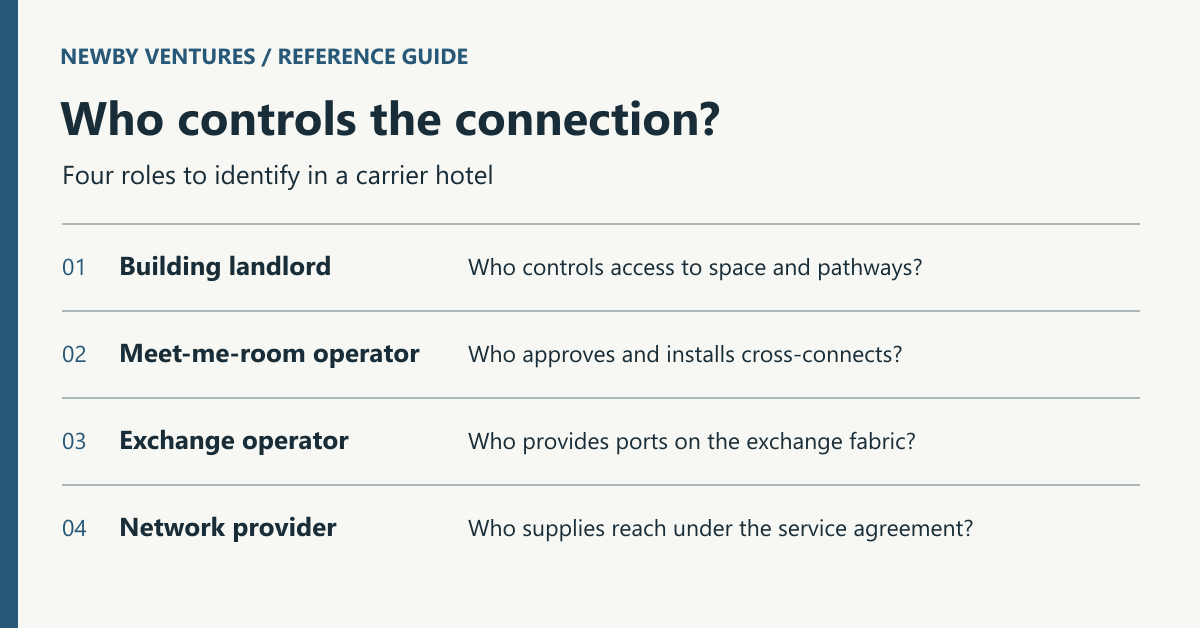
The landlord controls the real-estate rights described in the relevant agreements. A meet-me-room operator manages a shared interconnection environment. An exchange operator provides an exchange service. Carriers and other service providers sell the connectivity used by customers. One company may perform more than one role.
That overlap does not eliminate the need to identify responsibilities. Ask which legal entity signs each agreement and which operating team approves installations, maintains equipment and handles incidents. Keep the answer specific to the location and service being considered.
Hunter Newby's ownership framework
In his comparison of exchange and real-estate control, Hunter Newby distinguishes integrated and separated roles. That is a useful lens for carrier hotel ownership models because it asks whether the facility business and exchange service share an owner or operate independently.
The terminology needs care. Hunter uses IX to distinguish the exchange function and IXP to emphasize the real estate supporting it. Other industry sources use IXP more broadly for exchange infrastructure. The practical objective is to identify the building, service and operators clearly, not to assume that every supplier uses identical labels.
Three carrier hotel ownership models to examine
The structures below are illustrative. They are not claims about the current organization or conduct of a named provider. In real transactions, leases, operating agreements and service contracts can produce variations.
| Illustrative structure | Possible administrative advantage | Question to resolve |
|---|---|---|
| Building and meet-me room under one operator | A common party may coordinate room and building work | Which services, fees and rights are actually covered by that party? |
| Landlord with independent meet-me-room operator | Separate organizations can specialize in different responsibilities | How do the lease and operating agreement handle access and continuity? |
| Facility with an independent or affiliated exchange | Facility and exchange services can be evaluated as distinct components | Can participants obtain the exchanges and network services they require? |
Ownership does not answer the neutrality question alone
Carrier hotel ownership models describe control, but they do not prove that a particular operator treats competitors unfairly or provides equal access. An integrated organization may offer practical choice. A separated structure still needs workable contracts, coordination and rules.
Request the policies that affect your planned deployment: admission of providers, permitted connections, installation approval, pricing basis and service escalation. Ask how a competing service can enter or operate in the facility. Distinguish a general policy statement from a right that is actually available to your organization.
Hunter's published discussion of neutrality explains the historical importance of physical access. Apply that context to present contracts without turning a historical account into an unsupported allegation about a current business.
Complete a control-and-responsibility matrix
For each of the four roles, record the legal entity, contact route, authority and evidence. This original worksheet makes carrier hotel ownership models actionable: it connects an ownership description to the decisions that determine whether the installation can proceed.
- Fees: who sets and bills room, connection and service charges?
- Installation: who approves work and access to shared pathways?
- Interconnection: where are the physical and commercial demarcations?
- Choice: which written rules govern competing networks and exchanges?
- Incidents: who opens, owns and escalates a multi-party fault?
- Continuity: what changes if the building, operator or service contract changes hands?
Test the model with an ordinary change request
Consider a hypothetical tenant adding a second network provider. Ask each party to describe the sequence from order to usable connection, including approvals and dependencies. A diagram of corporate ownership will not tell you whether the landlord, room operator and carrier have coordinated that sequence.
Then test an incident: the physical connection exists, but the expected service is unavailable. Which team investigates first? What evidence passes between suppliers? Who communicates with the customer? These questions can expose an ambiguous responsibility before it becomes an operational delay.
The most useful comparison of carrier hotel ownership models ends with a documented operating path. Do not assign a universal winner to integration or separation. Select the structure whose available rights, responsibilities and services fit the deployment.
Frequently asked questions
Does owning the building mean owning its exchange?
No. Building ownership, room operation and exchange operation can be separate roles. Confirm each one for the particular location.
Can an integrated operator provide neutral access?
Yes, ownership alone does not settle the question. Assess the actual rules, available services and contractual rights.
Do carrier hotel ownership models determine every connection fee?
No. The relevant agreements establish fees and billing responsibility. Ownership helps identify the parties to question.
Does a neutral label prove equal practical access?
No. Request the rules and conditions governing the exact connection or service you need.
Are IX and IXP used identically by everyone?
No. Define the terms used in the discussion and identify the physical infrastructure and service operators explicitly.
What should a buyer request first?
Ask for a role map with legal entities, demarcations and responsibilities, then obtain the agreements and policies that support it.
About the Author

Hunter Newby
Founder, Newby Ventures
Entrepreneur, investor, and interconnection pioneer. Co-founded Telx, conceived the carrier-neutral Meet-Me-Room, and led data center development across the U.S. Now investing in network-neutral infrastructure through Newby Ventures.
Read more about Hunter →