

Meet Me Room: Connections, Control and the Buyer’s Checklist

Hunter Newby
November 23, 2026
A meet me room is shared interconnection space where networks bring physical connections together. It supports connections between participating parties, but the room, cabling, network services and contractual rights are separate parts of the arrangement. Buyers should identify the operator, authorized endpoints, charges and maintenance responsibilities before treating a connection as a complete service.
Choosing a meet me room starts with the network you need to reach and the service you intend to use. A recognizable building or a long carrier list is useful background. The purchase still depends on a current, authorized path between the correct endpoints and the agreement that makes that path useful.
- Identify the physical endpoints and the parties allowed to connect them.
- Separate cabling work from the network service delivered over it.
- Keep installation records, charges and incident responsibilities together.
A meet me room connects networks; its services need definition
Hunter Newby's published account of building neutrality distinguishes interconnection from hosting and compute. A room containing fiber distribution panels has a different purpose from a deployment built around GPU equipment. Its presence does not establish the computing capacity of the surrounding property.
Translate that distinction into the purchase order. Describe the particular connection, the associated service and who supplies each part. The operator of the building, the operator of the room, the installer and the network service provider may have different responsibilities.
Follow one connection from request to handover
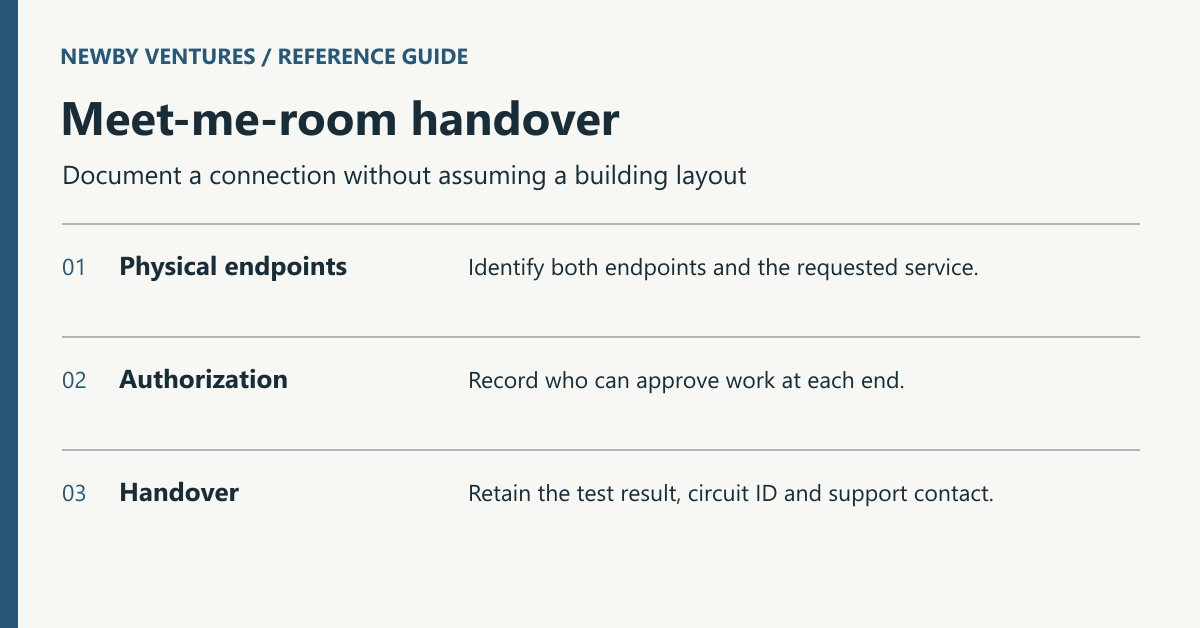
Start by confirming the destination and the correct demarcation: the point at which responsibility changes between parties. Then confirm the required authorization, connection specification, installation process and acceptance evidence. A diagram is useful only when its endpoints correspond to the actual order.
For a concrete provider example, Equinix documents cross-connects as physical cabling links. Its extended offering can connect an IBX location to a third-party building interconnection room. This shows why buyers should verify the full path, rather than assume every connection stays within one operator's premises.
The meet me room order should identify who installs each segment and who confirms the completed connection. Keep the service activation separate from the cabling handover if different parties own those steps.
Understand authorization without assuming one universal workflow
A letter of authorization gives permission for a defined connection or action involving another party's resource. Equinix's digital LOA documentation describes request, issue and authorization responsibilities within its own workflow. Other operators can use different systems and rules.
Before submitting an order, confirm the authorized resource, issuing party, recipient and any applicable validity conditions. If an endpoint changes, ask whether the authorization remains valid. Do not treat a document bearing a familiar company name as permission to connect any available port.
Meet me room cabling standards: match the order to the handover
Start by asking which standard and edition govern the project and which separate rules the building applies to cross-connects. ANSI/TIA-942-C covers data-center infrastructure, including telecommunications. It is not the order sheet for your circuit. The facility and network operators still have to agree on the handoff and acceptance criteria.
Use one line in your worksheet per cable segment. Record these four items so the person receiving the order can tell what was actually delivered:
- Endpoints: Write the building, room, panel and port for each end exactly as the order names them. Match the far end to the applicable authorization. Equinix's order instructions show how one provider collects those far-end details; the other building may use a different process.
- Specification and owner: Record the agreed media and connectors and who supplies the patch from the panel to the equipment. Do not assume the party that installs the in-building link also supplies the jumper.
- Handover record: Match the installed endpoint labels and circuit ID to the order. Record who delivered the agreed test record and who accepts it. Track service activation separately, even when the same provider sells both.
- Charges: Put installation and any quoted testing or patch work in the one-time column. List each recurring cable or transport charge separately, with the billing start and responsible party. Record charges as quoted, not as typical for the market.
Suppose a handover names a different far-end port from the authorization. Ask the operator to reconcile the records before accepting the circuit, even if the installation notice says complete. Hunter Newby's 60 Hudson account explains why direct cross-connects removed a costly intermediary in his experience. The willingness to authorize the connection and the cost of each segment still come from today's order.
Keep a ten-question operator checklist
Use this original meet me room checklist during the pre-order discussion. Record each answer with its source and date. An unresolved item should have a named owner and a clear next step.
| Question | Useful evidence |
|---|---|
| Which network and service are needed? | Current service confirmation |
| What are the exact endpoints? | Demarcation and panel records |
| Who authorizes the connection? | Applicable authorization record |
| What media and termination are supported? | Current provider specification |
| When can installation and service activation occur? | Separate confirmed milestones |
| Which charges apply? | Installation, recurring and change terms |
| How are later changes requested? | Documented change process |
| Who maintains each segment? | Responsibility and support record |
| What diversity is actually provided? | Evidence for the relevant paths |
| Who owns incident escalation? | Current operational contacts and procedure |
This checklist organizes a discussion; it does not replace the operator's contract or technical instructions. Keep the final answers with the order so future teams can understand what was purchased.
Check diversity, documentation and incident ownership
Two connections do not automatically establish two independent physical paths. Equinix's documentation explicitly notes that connections inside an IBX are not guaranteed to follow diverse routes. Ask the actual provider what separation is supplied for the service under consideration, including any shared segments.
For a meet me room deployment, maintain clear connection identifiers and handover records. If a service fails, the team needs to distinguish equipment, cabling and upstream-service responsibilities before it can direct the incident effectively.
Consider an illustrative buyer with a completed cable installation but no working service. The first task is to compare the ordered endpoints, acceptance record and service activation status. Ordering another cable without resolving the mismatch could repeat the same problem. This is a hypothetical operating example, not a reported customer incident.
Compare complete connection arrangements
A useful quote identifies the connection scope, initial work, recurring charges, change terms and service boundaries. Compare these together. A low quoted component price can be misleading if the buyer has not identified the other resources required to complete the arrangement.
The value of a meet me room is the ability to establish useful physical interconnection under workable conditions. Newby Ventures' carrier-hotel history supplies wider context; the current order and its supporting evidence determine what a particular buyer can use today.
Meet-me-room cost: build the first-year total by segment
A quote marked cross-connect may stop at a patch panel. Before you compare two prices, draw the path the buyer is actually paying for: equipment to panel, room-to-room cabling, then any extension to a second building. Write the provider, start date and price on each segment. A blank line means you still need a quote; it does not mean the work is free.
- Due at installation
- Ask for the itemized order covering installation, patch work and any separately ordered test or labor. Record which party pays each line.
- Due each month
- Separate the in-building connection, any offsite extension, and the network service itself. Note when each charge starts, especially if cable completion and service acceptance are on different dates.
- Due at change or exit
- Read the order for moves, additional labor, removal charges and any remaining commitment. Do not assume the installation payment covers removal.
For a worksheet example, suppose installation is $180 and separate patch work is $125. The in-building segment is $40 a month, and a separately quoted building extension is $150 a month. With 12 months of both recurring charges, the connection path totals $2,585 in year one: $305 upfront plus $2,280 recurring. The example excludes network service, taxes, and exit charges; it is not a vendor quote. If the same service can be reached without an extension, replace that line using the actual alternative quote and keep the other assumptions visible.
Equinix's billing guide distinguishes several connection products with different one-time and recurring structures. Use it as an example of what can differ, not as a price list or a rule for another building.
Frequently asked questions
Is a meet me room the entire data center?
No. It is interconnection space within a broader physical and commercial arrangement. Other parts of the facility can serve different functions.
Is a cross-connect the same as Internet service?
No. A physical connection can support a service, but the cabling and the service agreement have distinct roles.
What does an LOA establish?
It authorizes a specified connection or action involving an identified resource. Confirm the scope and current rules with the relevant provider.
Does the landlord always operate the room?
No. Identify the contracted operator and the responsibilities of the landlord, installer and service provider for the actual site.
Do two cables guarantee route diversity?
No. Request evidence of the physical separation supplied, including any shared route segments or components.
What should be retained after installation?
Keep the order, authorization, endpoint identifiers, acceptance record, charges, service activation details and current escalation procedure.
About the Author

Hunter Newby
Founder, Newby Ventures
Entrepreneur, investor, and interconnection pioneer. Co-founded Telx, conceived the carrier-neutral Meet-Me-Room, and led data center development across the U.S. Now investing in network-neutral infrastructure through Newby Ventures.
Read more about Hunter →