


GPU Cluster Networking: Separate the Fabric from the User’s Path

Hunter Newby
November 23, 2026
GPU cluster networking connects accelerators with one another and with the systems that supply data, control operations and serve users. These connections perform different jobs. A useful design review distinguishes local accelerator communication, communication across compute nodes, storage access, management and external connectivity before comparing any advertised speed or latency figure.
A GPU cluster networking purchase should start with a description of the workload. Training, fine-tuning and inference can move data in different patterns. The right questions concern the actual application, its supporting infrastructure and its users, rather than a single impressive number copied from a component specification.
- Identify the traffic and operating owner for every network path.
- Measure cluster performance and user experience separately.
- Verify physical capacity and commercial delivery alongside the fabric.
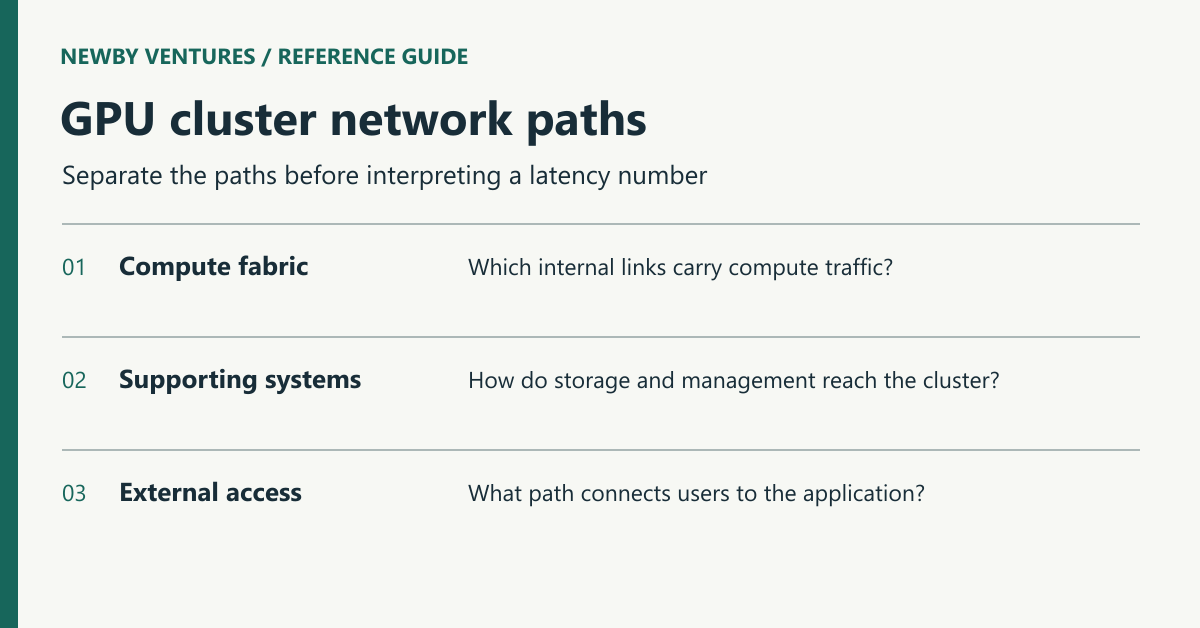
GPU cluster networking includes several distinct paths
NVIDIA's NCP architecture documentation distinguishes tenant access, secure management, cluster interconnect and NVLink roles. In that reference design, scale-up communication is local to an accelerator domain and scale-out communication connects GPU racks. Those are architecture-specific descriptions, not a universal shopping specification.
A buyer can translate the terminology into the following questions. The table is an original review worksheet; it does not prescribe hardware, topology or link capacity.
| Path | Practical question | Evidence to request |
|---|---|---|
| Local accelerator communication | Which accelerators cooperate closely? | Supported server or rack architecture |
| Compute-node communication | What crosses the cluster fabric? | Representative workload and fabric measurements |
| Storage and data movement | How does useful data reach compute? | Storage access pattern and loading measurements |
| Management | How are systems configured and recovered? | Access controls and operating responsibility |
| External access | Where do requests and responses travel? | User locations, routes and service boundaries |
Separate application response time from fabric measurements
A measurement inside the cluster cannot establish the complete delay experienced by a remote user. Application processing, queues, data access and the external network can all affect that experience. Define where a measurement starts and stops before comparing results.
NVIDIA's HGX reference architecture describes separate roles for GPU communication, CPU and storage traffic, customer connectivity and management. Its particular configuration is a useful example of the distinction, not proof that another deployment will perform the same way.
For GPU cluster networking, ask for the workload, software version, concurrency, message sizes, measurement endpoints and test conditions behind a performance claim. Missing context can make an accurate component number unsuitable for a business decision.
Use four gates to check whether the deployment can operate
Hunter Newby's discussion of AI and interconnection places compute requirements alongside physical connectivity and the supporting location. The procurement implication is practical: usable equipment, usable premises and usable network access must come together.
This original four-gate worksheet complements a GPU cluster networking design review. Assign a named owner and a dated evidence record to each gate.
| Gate | Question | Evidence owner |
|---|---|---|
| Building and installation | Can the equipment be installed and serviced as proposed? | Facility and installation teams |
| Power and cooling | Is the required capacity available for this deployment? | Facility operator and engineering team |
| Network reach | Can compute, data and users reach the required destinations? | Network and application teams |
| Commercial delivery | Which resources and milestones are actually committed? | Contract and service owners |
A marketing label or future expansion plan is not a completed gate. Record unresolved dependencies explicitly, including who can close them and what evidence constitutes completion.
Work through a representative inference service
Consider an illustrative company serving a regional application. Its model performs acceptably in an isolated test, but the purchasing team still needs to investigate request routing, data retrieval, concurrent demand and recovery procedures. This example describes a review process; it does not report a measured customer result.
The team tests the complete request path under agreed conditions and separately examines the cluster's internal behavior. If the problem appears outside the fabric, buying a faster internal connection may leave the relevant bottleneck unchanged. If accelerator communication is limiting the workload, an external-network change may be equally misplaced.
A useful GPU cluster networking acceptance plan therefore records both the internal performance objective and the user-facing objective, with an owner responsible for explaining differences between them.
Turn the review into a clear acceptance record
Before committing, keep the architecture diagram, service scope, test method and operating handover together. Make the acceptance criteria specific enough that the buyer and supplier can determine whether the delivered system meets the agreed requirement.
- Define the representative workload, users and data sources.
- Identify physical and logical boundaries, including third-party services.
- Agree which measurements demonstrate capacity, performance and recovery.
- Record responsibility for configuration, monitoring, changes and incidents.
- Separate installed resources from future expansion or optional capacity.
- Retain dated results and explain any departure from the agreed method.
The commercial value of GPU cluster networking comes from an operating system that supports its intended workload. A defensible purchase links each claimed capability to evidence and a responsible party, while leaving detailed engineering decisions with the qualified implementation team.
Frequently asked questions
What is GPU cluster networking?
It connects accelerators and the supporting compute, storage, management and external systems needed to operate an AI workload.
Are scale-up and scale-out the same?
They describe different communication scopes. Confirm how the selected architecture defines local accelerator connectivity and communication across nodes or racks.
Does a fast fabric guarantee fast answers for users?
No. The complete application path also includes processing, queues, data access and external connectivity. Measure the user-facing objective separately.
Must every cluster use the same network technology?
No. Workload requirements, supported architectures and operating constraints determine the appropriate design. A reference configuration is not universal.
Why include power and cooling in the review?
The networking and compute equipment must operate in a suitable physical environment. Verify the resources available to the specific deployment.
What should a buyer ask for before acceptance?
Request the agreed architecture, responsibilities, representative test method, dated results and explanation of any unresolved delivery dependencies.
About the Author

Hunter Newby
Founder, Newby Ventures
Entrepreneur, investor, and interconnection pioneer. Co-founded Telx, conceived the carrier-neutral Meet-Me-Room, and led data center development across the U.S. Now investing in network-neutral infrastructure through Newby Ventures.
Read more about Hunter →