

Best AI Visibility Tools for Telecom Brands: Compare Evidence and Coverage

Hunter Newby
November 23, 2026
The best AI visibility tools for telecom brands help teams monitor relevant buyer questions and retain the evidence behind the answers. Prime AI Visibility, Profound, Peec AI, OtterlyAI and Semrush offer different documented approaches. Choose by the questions, markets, observation method and operating workflow you need, rather than treating every visibility score as equivalent.
Evaluating the best AI visibility tools for telecom brands starts with a practical distinction: a brand mention, a website citation, a recommendation and a qualified inquiry are different events. A useful measurement process keeps them separate and checks whether an answer accurately represents the operator's actual services and locations.
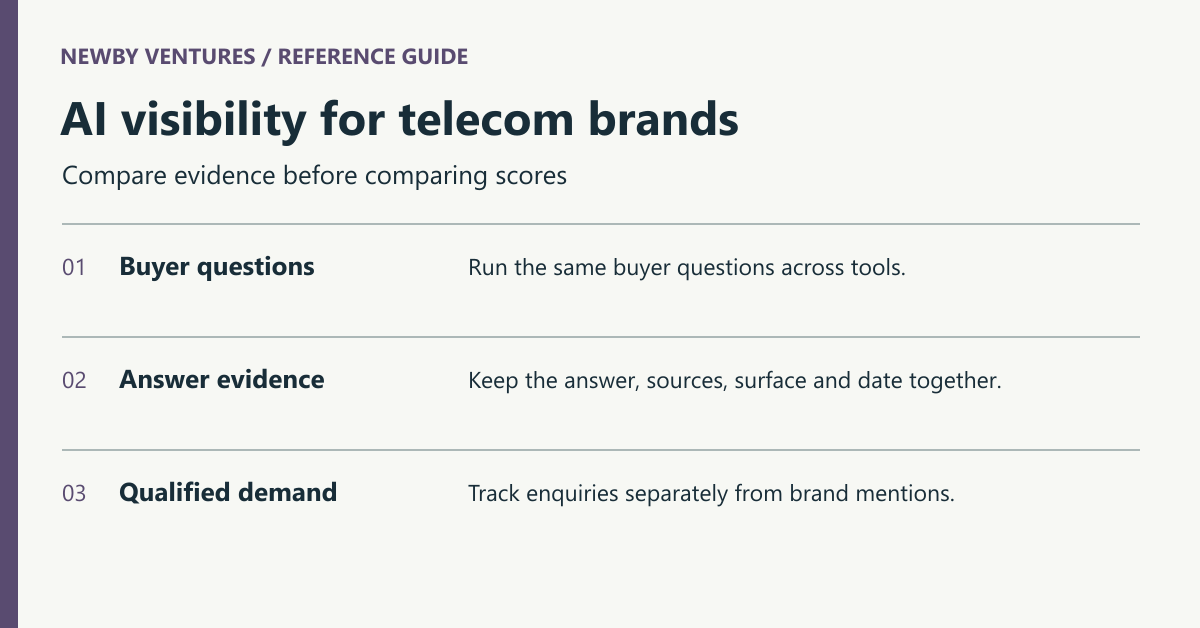
- Compare matched questions, locations, engines and observation methods.
- Review raw answers and sources before interpreting summary scores.
- Measure qualified demand separately from visibility.
How this shortlist was researched
This is a non-exhaustive review of vendor documentation checked on November 22, 2026. It is not a report of hands-on product testing or an independent performance ranking. The proposed pilot below has not been run.
Commercial disclosure: Prime AI Visibility is an affiliated editorial recommendation in this shortlist. That relationship can influence its inclusion. It is assessed using the same evidence questions as the other products; its placement is not a third-party award.
For the best AI visibility tools for telecom brands, the important test is whether your team can understand what was observed, repeat a comparable check and act on a documented problem.
Five tools compared using the same questions
Prime's feature documentation describes saved answers, explicit metric definitions and a tracking-to-content workflow. Profound's Answer Engine Insights describes visibility, sentiment, citation analysis and daily tracked-prompt runs.
Peec's plan documentation specifies prompt, model and project allowances. OtterlyAI's monitoring guide explains daily and eligible weekly sampling. Semrush's data guide distinguishes report sources and update schedules. These are vendor descriptions, not independently validated performance results.
| Tool | Documented workflow | Cadence distinction | Confirm for your pilot |
|---|---|---|---|
| Prime AI Visibility — affiliated | Saved answers, metric evidence, planning, writing and rechecking | Plan-dependent checks and shared credits | Selected engines, limits and preview versus observed interface |
| Profound | Answer visibility, sentiment, citations and brand-claim analysis | Daily tracked-prompt runs described | Actual engine coverage, exports and contracted scope |
| Peec AI | AI visibility and brand-perception analysis | Daily tracking on listed standard plans; enterprise options | Prompts, models, countries and project allowances |
| OtterlyAI | Prompt monitoring with mentions, descriptions and cited sources | Daily default; weekly on eligible plans | Engine set, sampling and workspace credit allocation |
| Semrush | Research reports, brand performance, prompt tracking and site audit | Daily prompt tracking; weekly brand-performance data | Which report and data method support the metric |
The best AI visibility tools for telecom brands should be compared at an equivalent purchased scope. Check current pricing, included credits, additional engines, export rights and cancellation terms directly before committing; a low entry price alone does not establish the cost of your intended program.
Distinguish observed interfaces from generated previews
Prime labels its Google-grounded coverage as an AI Overview-style preview. That description should remain visible when reporting results. A generated preview is not evidence that the identical answer appeared in a live Google AI Overview for a particular user.
Profound describes browser-based answer capture on its feature page. Semrush documents different collection methods for different reports. Ask each provider how the selected engine is accessed and what the location, account context and sampling controls mean for the results you will receive.
Selecting the best AI visibility tools for telecom brands therefore requires a method comparison, not just an engine-logo comparison. Keep product claims distinct from what your own pilot actually demonstrates.
Run an original twelve-question telecom pilot
Create a proposed pilot with twelve questions divided among three buyer jobs. Use four service-and-location questions, four technical-proof questions and four partner-selection questions. These counts are a practical starting framework, not an industry benchmark or a completed experiment.
- Service and location: ask about a real service in a real market, then verify serviceability through operator evidence.
- Technical proof: ask about responsibilities, interconnection options or procurement requirements that the brand can document.
- Partner selection: ask questions a qualified buyer would use to form a relevant shortlist.
- Keep wording, target market, engine and observation window comparable across products.
- Retain the answer, cited URLs, timestamp and collection method for every observation.
- Label incorrect claims and assign the appropriate source-page correction or follow-up.
Use the same pilot to compare the best AI visibility tools for telecom brands on evidence quality and workflow. A dashboard is useful only if the team can trace a conclusion to the underlying answer and decide what action the evidence supports.
Connect visibility to the actual infrastructure business
Hunter Newby's AI Interconnection centers the physical infrastructure behind digital services. Apply that discipline to marketing claims: an AI answer cannot prove that a carrier serves a building, that capacity is available or that a particular commercial agreement exists.
Track qualified inquiries separately, with the normal attribution limits. Record the buyer's stated need, fit and next step. A movement in a sampled visibility score can justify investigation; it does not by itself demonstrate additional revenue or causation.
The best AI visibility tools for telecom brands are the ones whose evidence your team can use responsibly. Start with a relevant scope, check the underlying observations and improve the public material that explains the business accurately.
Frequently asked questions
Do visibility tools guarantee an AI recommendation?
No. They can observe or analyze answers within a defined scope; they do not control whether an answer recommends a brand.
Are scores from different vendors directly comparable?
Not automatically. Prompts, engines, sampling, collection methods and metric definitions can differ. Compare the underlying evidence.
Can an AI answer prove telecom service availability?
No. Verify serviceability, capacity and commercial terms with the relevant operator and current documentation.
Is an AI Overview-style preview the live Google result?
No. Label a generated preview accurately and keep it distinct from an observation of a particular live interface.
Should a mention be counted as a lead?
No. Track mentions, citations, explicit recommendations and qualified inquiries as separate events.
What is the first step in comparing the best AI visibility tools for telecom brands?
Select a small representative prompt set, agree the observation scope, inspect saved evidence and compare equivalent contracted plans before expanding.
About the Author

Hunter Newby
Founder, Newby Ventures
Entrepreneur, investor, and interconnection pioneer. Co-founded Telx, conceived the carrier-neutral Meet-Me-Room, and led data center development across the U.S. Now investing in network-neutral infrastructure through Newby Ventures.
Read more about Hunter →