


What Is Peering? Public, Private and Remote Connections Explained

Hunter Newby
November 23, 2026
What is peering? It is an arrangement in which networks exchange traffic directly for the destinations covered by their relationship. Peering can use an Internet exchange or a private interconnect. It differs from buying transit for broader Internet reach, and a settlement-free arrangement does not make ports, transport, equipment or operations free.
A useful answer to what is peering starts with the traffic a network wants to exchange. Identify the destinations, the counterpart networks and the connection options, then compare the agreements and operating work. A peering label alone does not establish complete Internet reach or a particular performance improvement.
- Peering is a network relationship, supported by a physical or logical connection.
- Public, private and remote options create different dependencies.
- Settlement terms and the total cost of operating the connection are different questions.
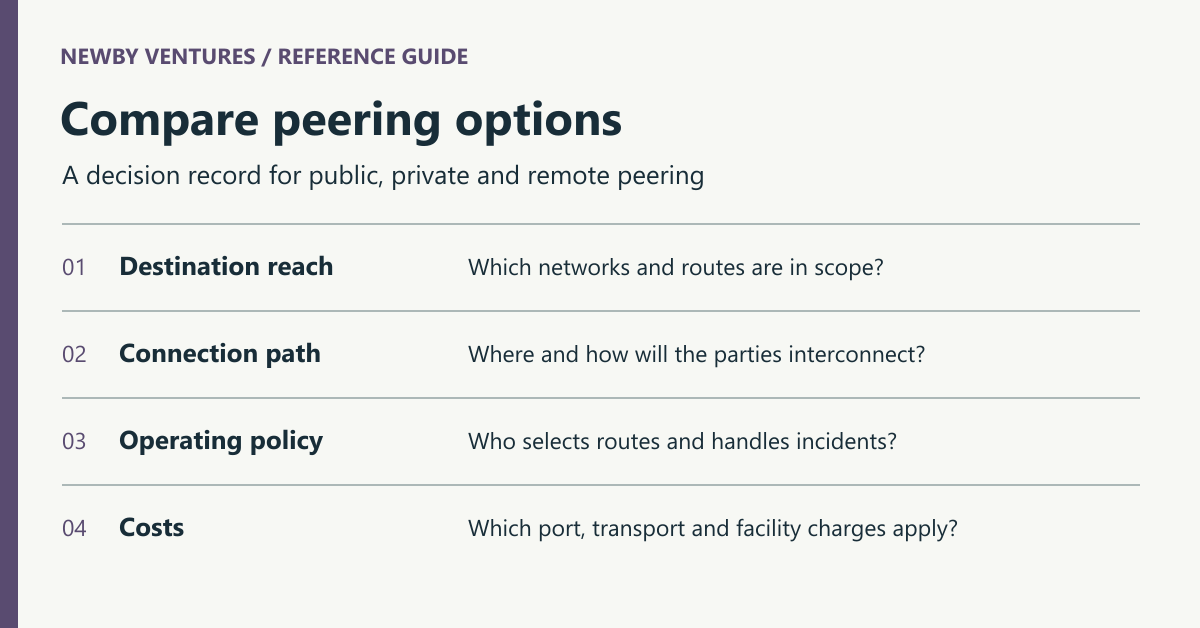
What is peering in a simple traffic-path example?
Imagine one network serving users and another serving content those users request. The networks may arrange to exchange the relevant traffic directly. Their agreement and routing policies define the reach available through the relationship; it is not automatically a route to every other destination.
Cloudflare's peering explainer provides a provider perspective on the distinction. A practical buyer should turn that definition into a destination list and a current policy discussion with the proposed counterpart. The example here is illustrative and assumes no measured savings.
Peering and transit answer different reach questions
Transit is purchased to provide reach through an upstream network under the service agreement. A peer relationship covers the routes exchanged under that relationship. Many networks use a combination rather than treating the two as mutually exclusive choices.
When an organization asks what is peering worth for its deployment, first establish which traffic might use it and what reach must remain elsewhere. Compare the complete operating plan, including dependencies and failure scenarios. Do not assume that one new peer connection permits every existing service to be removed.
Compare public, private and remote arrangements
This original decision table separates connection choices from promises about outcomes. The actual exchange, provider and peer policies determine what can be ordered and how it must be operated.
| Arrangement | What to examine | A question before ordering |
|---|---|---|
| Public peering at an exchange | Exchange access and participation in the available routing relationships | Which desired networks and routes will actually be available? |
| Private interconnection | The dedicated connection arrangement between parties | Who supplies and supports each physical segment? |
| Remote exchange access | The transport or reseller path to an exchange | Where are the service handoffs and shared dependencies? |
| Transit | Upstream reach and the contracted service | Which destinations and operating commitments are covered? |
Public does not mean that every network must accept every peer. Private does not mean that every physical dependency disappears. Remote access adds a service path that should be documented. These qualifications make the comparison useful without turning it into a universal preference.
Settlement-free is not cost-free
The answer to what is peering often includes settlement-free traffic exchange. That describes the settlement arrangement between the relevant parties; it does not erase the cost of reaching and operating the connection.
Build an itemized view of ports, cross-connects, transport, equipment, support and operating work where applicable. Obtain current quotes and identify contract terms. Whether an option is economically attractive depends on the actual requirement and alternatives, not an invented universal traffic threshold.
Separate one-time installation from recurring charges and from internal work. A proposal may move a task to your own network team even when a supplier's invoice appears lower. Record that responsibility explicitly.
Check the operating policy before the connection
Current peer policies matter. For example, Cloudflare's published policy sets operational expectations for potential peers. Use it as an example of why a policy must be read, not as a universal rule for every network.
What is peering operationally? It is an ongoing relationship involving route exchange, contactability, monitoring and policy maintenance. Assign owners for configuration, route filtering, incidents and changes. Apply the specific operator guidance and the network's own security requirements.
At an exchange, a route server can simplify distribution of routing information among participants. DE-CIX's route-server documentation illustrates why policy controls and service instructions remain necessary. A route server should not be confused with a transit router carrying all data traffic.
BGP peering: what proves the connection is usable?
BGP peering lets network operators exchange reachability information. An autonomous system number (ASN) identifies a network in that exchange. An established session tells you the two BGP speakers can talk. It does not tell you that either side accepted the routes you need or that traffic is using the intended path.
- Do you have the right access? Match the exchange or private handoff in the operator's order to the facility and port the network can reach. Treat a directory entry as a lead, not confirmation that the network accepts your peering request.
- Which ASNs will exchange routes, and how? Ask for written confirmation of the neighbor ASNs, supported address families, and bilateral or route-server arrangement. If a network you need is not available through the route server, confirm a bilateral option before counting on it.
- What will each side accept? Keep a short record of expected destinations in each direction and the operator's published routing policy. Ask the network team which checks apply to route origin and permitted announcements. A session can stay up while a route is rejected by policy, and origin validation alone does not validate the entire path.
- What changed at handover? Keep the dated acceptance record for the routes actually exchanged and the separate traffic-path observations for the destinations in scope. If one is missing, record the open item and the team responsible. Keep the port, transport and cross-connect terms with that record so an accepted route is not mistaken for a cost saving.
For example, a provider can confirm a private handoff and an established IPv4 session while the intended IPv6 route is still absent. The handoff is delivered; the IPv6 requirement is not. That distinction gives the two teams a specific issue to resolve before counting the new path on their coverage report.
RFC 4271 distinguishes routes received from routes selected under local policy. Hunter Newby's chapter on exchange switches and real estate explains why the facility and exchange are separate questions.
Use a documented decision sequence
First, identify the destinations and the business reason for changing the connection. Second, confirm counterpart availability and policy. Third, map the physical and commercial path. Fourth, compare the full cost and operating scope. Finally, agree the test and rollback plan with the responsible network team.
Hunter Newby's account of neutral interconnection explains why practical physical access matters to network choice. That historical perspective supports better questions; it does not establish that one current path will outperform another without measurement.
A complete answer to what is peering ends with a verified relationship and a manageable operating plan. Keep the chosen routes, agreements, evidence dates and incident responsibilities alongside the deployment record.
ISP peering strategy: follow the traffic to the invoice
Decide which destinations need a different path before comparing prices. If your ISP needs broad Internet reach, keep that requirement in the transit comparison. If several willing networks carry the traffic you want to move, price a shared exchange. If the requirement is concentrated with one network that will agree to a direct handoff, compare a private interconnect with that exchange option.
- Transit: Keep the order and billing terms for the baseline. Identify any committed minimum, how usage above it is billed, and when a commitment can change. An unchanged minimum is not an avoidable expense.
- Exchange: Keep the operator's service order with the exchange port, access location and terms. List the separate transport, cross-connect and any membership fee. For instance, AMS-IX documents a remote offer that bundles transport with the peering port; don't count the same transport twice in a bundled quote.
- Private interconnect: Keep the counterpart's acceptance and both end orders. Identify which party pays for the port, facility connection and transport, plus who retains any backup network service. A private session is not broad Internet reach.
In a hypothetical comparison, an exchange path adds $500 a month and an upfront $900. If the actual transit bill falls by $650 a month, the monthly difference is $150 and the upfront cost is recovered after six months at that rate. If the transit bill stays at its contracted minimum, the new path adds $500 a month instead. Neither figure is a market rate or a reason to prefer a path without checking the service it provides.
Put the expected traffic change and the expected invoice change on separate lines. Use the accepted route evidence above to support the first one, and the actual contract terms to support the second.
Frequently asked questions
What is peering's relationship to transit?
Peering exchanges routes and traffic covered by the peer relationship; transit supplies contracted upstream reach. They can coexist in one network plan.
Is all peering settlement-free?
Commercial arrangements differ. Confirm the specific terms and keep them separate from the physical and operational costs of connecting.
Can a new peer connection replace all transit?
Not automatically. First establish the complete destination reach and failure requirements of the network.
Can any network peer with any other network?
No. Availability, technical requirements, policies and agreements govern the relationship.
What should buyers verify about remote peering?
Identify the transport path, service handoffs, support ownership and shared dependencies, then assess the actual routing and commercial arrangement.
What is the first useful peering measurement?
Define the destinations and conditions that represent the service requirement, record a baseline and compare the proposed arrangement using an agreed test. No single universal result applies.
About the Author

Hunter Newby
Founder, Newby Ventures
Entrepreneur, investor, and interconnection pioneer. Co-founded Telx, conceived the carrier-neutral Meet-Me-Room, and led data center development across the U.S. Now investing in network-neutral infrastructure through Newby Ventures.
Read more about Hunter →