


Fiber Optic Route Survey: What to Ask About Conduit and Right-of-Way

Hunter Newby
November 24, 2026
A fiber optic route survey tells a buyer what a carrier can deliver between two handoffs, which permissions it has, and what remains an estimate. Ask for three things separately: the status of the physical path, the right to use it, and the conditions under which the finished service must meet its delay target.
A supplier can quote a short route without having the right to use every part of it. A second supplier can offer a longer route that's already in service. Comparing their monthly prices won't settle which one can meet your opening date. Ask both suppliers to put a date, a responsible party and an exception beside each material assumption.
Read the survey | Check conduit and rights | Compare latency budgets | Agree on acceptance | Buyer questions
What does the survey actually cover?
Start with the endpoints on the service order. A quote to a carrier's equipment in the building isn't necessarily a quote to the customer's handoff. Write down who supplies the final connection, who bills for it, and whether its installation is included in the delivery date. In his chapter on physical interconnection fundamentals, Hunter Newby describes how networks meet at particular facilities. Two networks serving the same city still need a physical place and a commercial arrangement to exchange traffic.
Ask the supplier to label its distance as estimated, surveyed or installed. An estimate may be enough to compare bids. A dated survey can support a design, subject to exceptions. An installed-length record describes what was built, but still doesn't tell you which path a routed service will use. Ask when the record was last checked and whether the quoted service relies on a third party. Keep detailed drawings with authorized project staff; a buyer's comparison usually needs a dated attestation and a list of exceptions.
Is there space, and who can authorize its use?
A conduit is the physical duct. A right-of-way or easement concerns use of property. Permission to occupy somebody else's duct is another question. An agreement covering one does not, by itself, establish the others. The Fiber Optic Association's outside-plant design guide treats route planning, permissions and documentation as distinct parts of the design. For a purchase decision, turn those distinctions into three entries in the bid:
- Usable capacity. Has the responsible operator confirmed space for this order? Ask for the confirmation date and whether capacity is reserved through installation. “Conduit exists” is an incomplete answer.
- Authority and scope. Who holds the relevant occupancy agreement or approval, what portion of the service does it cover, and what consent is still pending? Let the responsible rights holder or adviser interpret the actual instrument; don't infer rights from a line on a drawing.
- Effect on the order. If consent or capacity isn't available, who proposes an alternative, who approves a price change, and when can the buyer walk away? Distinguish a supplier's target date from a delivery commitment.
If diverse service is part of the purchase, ask for a written statement covering the two ordered services, the scope of the comparison and any exceptions. Different contracts or carrier names alone do not establish physical independence. A supplier that cannot attest to part of a third-party route can say so. Price the offer on what it can confirm.
What does the route length leave in the delay budget?
Suppose an application allows 4 milliseconds of network round-trip time between two handoffs. For an early comparison only, assume light travels 200 kilometers per millisecond in fiber and the return distance equals the forward distance. Divide total distance traveled by that speed. Use the carrier's optical path length where available, not road mileage or the straight-line distance between cities.
| Budget item | Offer A | Offer B |
|---|---|---|
| One-way fiber length assumed | 160 km | 200 km |
| Propagation, out and back | 320 km / 200 = 1.6 ms | 400 km / 200 = 2.0 ms |
| Left under the 4 ms target | 2.4 ms | 2.0 ms |
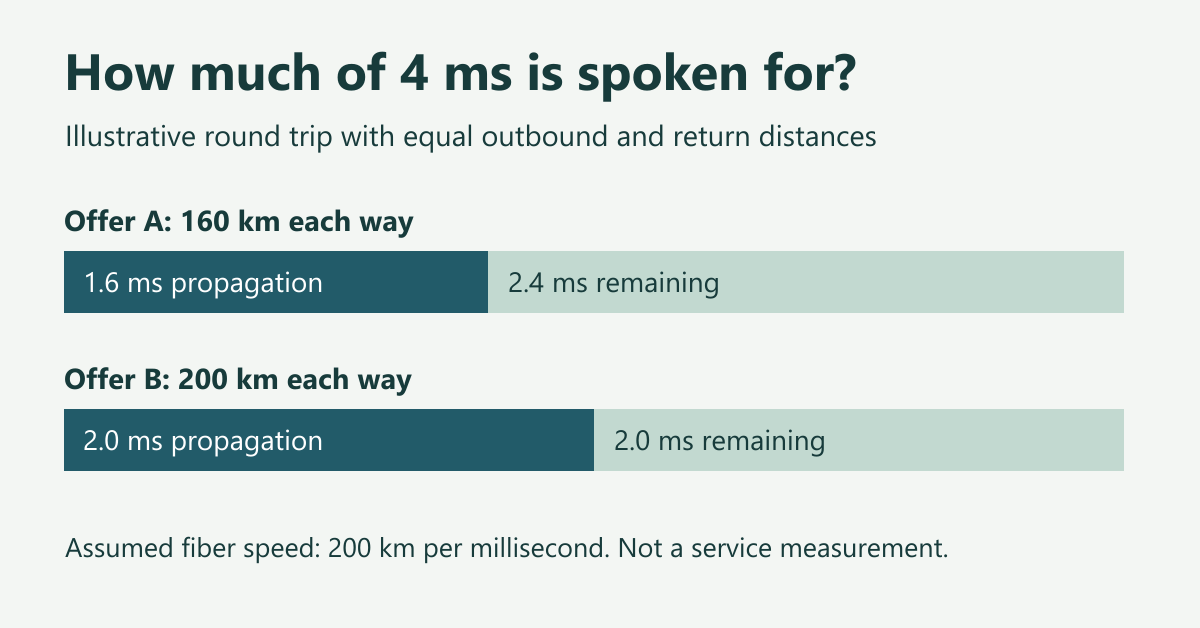
Offer A buys 0.4 ms more room in the model. It need not be the faster service in operation. Packet transmission, forwarding and queues consume part of the allowance; a change in routing can change the distance itself. Endpoint processing also affects an observed round trip. If the application takes several round trips per transaction, budget those trips separately from application processing. Don't deduct a one-way estimate from a round-trip target.
How should the buyer test the delivered service?
- Write the test into the order. Agree with the provider on the two authorized endpoints, service class, packet size, measurement period, reporting interval and traffic conditions. Define the target statistic: a 4 ms median is not a 4 ms limit on 95 percent of packets.
- Measure under the agreed conditions. Compare a baseline with a representative busy period on the ordered service. Record the distribution of round-trip times, variation, and how many sent packets failed to return before the agreed deadline. Report missing packets separately instead of silently dropping them from the sample.
- Locate the boundary of the claim. Round-trip time includes both directions. As the IETF explains in RFC 2681, the return path can differ from the outbound path. Neither a round-trip figure nor an IP hop count establishes cable geography. Request a provider explanation when measurements and the survey assumptions disagree.
- Record the decision. Retain the test window, method and result with the dated order. If the service misses the agreed threshold, name who investigates and when it will be retested. If it meets the threshold, accept that performance result without treating it as a certificate of physical route diversity.
This distinction also matters for peering and transit. A different interconnection arrangement can change where traffic is exchanged, its commercial terms and the routed path. It does not by itself change the length or rights of the access fiber you are buying. For a fuller explanation of the measurements, see Newby's network latency guide.
Questions to settle before signing
Does a desktop survey mean construction can start?
No. Ask which assumptions the supplier checked in the field, which permissions are in hand and who owns the remaining work. An indicative quote and an authorized construction order serve different purposes.
Can a buyer compare one provider's route miles with another's fiber miles?
Only after the providers define what each includes. Ask both to use the same endpoints and units and say whether the figures describe a design or the installed cable.
Is optical loss the same as lost packets?
No. An optical loss budget concerns signal power, commonly expressed in decibels. Packet loss counts packets that don't arrive under a defined measurement method. One result cannot stand in for the other.
Does a lower price mean the buyer assumes more build risk?
Not necessarily. Compare the inclusion of construction and building access, the start of recurring charges, and the treatment of a route change. The terms, not the price alone, allocate the risk.
Should the contract attach a public route map?
A public map isn't necessary for most comparisons. A dated, appropriately shared supplier record can identify the service, the scope of the review, any exceptions, and who will notify the buyer if the arrangement changes.
What belongs in the final acceptance file?
Keep the signed service description, the supplier's latest confirmation of permissions and availability, the agreed delay target, and the test result for the delivered handoffs. The next buyer or operations lead should be able to tell what was promised, what was measured and what is still open.
About the Author

Hunter Newby
Founder, Newby Ventures
Entrepreneur, investor, and interconnection pioneer. Co-founded Telx, conceived the carrier-neutral Meet-Me-Room, and led data center development across the U.S. Now investing in network-neutral infrastructure through Newby Ventures.
Read more about Hunter →