

Best AI Agent Platforms for Telecom Operations: Human Approval and Controls

Hunter Newby
November 25, 2026
The best AI agent platforms for telecom operations depend on what your team owns: a carrier incident queue, a radio network, a cloud workload or a customer account. Shortlist the platform that can show its evidence for that job. Then ask it to stop at the point where someone else must approve the next step.
Consider a customer whose calls drop at the same time a cloud alarm fires. Your service desk knows which customer called. Your cloud team can see a deployment. Neither observation tells you whether a carrier circuit failed. A useful agent can assemble that record without turning a coincidence into a diagnosis or telling the customer that service has been restored.
Compare four platforms | Score the evidence | Estimate the bill | Replay an incident | Buyer questions
Which platform fits the job you actually own?
Here, an agent is software that can use tools to gather evidence or propose or perform a task. Those are different permissions. This November 2026 shortlist compares four products using their providers’ documentation, not hands-on testing. Each was selected for a different part of the same incident. Listing order is not a performance ranking.
| Platform and fit | Evidence to request | Authority and cost |
|---|---|---|
| ServiceNow: cross-team service incidents | Trace an alarm to the affected service and its incident record. | Separate a recommended ticket update from an approved customer notice. Request a quote. |
| Nokia: network and radio assurance | Show which alarms and topology the proposed deployment covers. | Name the engineer who signs off on a network action. Request a scoped quote. |
| AWS DevOps Agent: cloud investigations | Link a proposed explanation to cloud changes, logs and traces. | Check investigation time and charges for reading connected services separately. |
| Salesforce Agentforce for Communications: customer service | Trace a disputed charge or service-level question to an account record. | Separate an explanation from a credit approval. Price the workflow on your contract. |
ServiceNow makes sense when the record that matters is the incident crossing several teams. Its Telecommunications Service Management packages place agentic workflows in Advanced; the Yokohama documentation distinguishes incident analysis from customer voice-quality work. Ask which inventory relationship links an alarm to a customer service in your instance. A ticket association is useful; it is not a line test.
Nokia is a candidate when the decision starts inside the network. Its June 2026 portfolio announcement describes network assurance agents and an agent library. For a mixed-vendor estate, bring an inventory from two equipment families. Ask which releases the quoted configuration supports and which records an engineer would still need to obtain elsewhere. Do not price a single-domain demonstration as fleet-wide coverage.
AWS DevOps Agent fits the cloud side of an incident. Its responsible AI guide describes investigations and the need to evaluate agent output. Ask for the underlying events and an alternative explanation, not just a confident summary. A change in an AWS workload may explain an application failure; it cannot, on its own, identify a fault on a leased local loop.
Salesforce Agentforce for Communications belongs on the customer-care shortlist. Salesforce’s February 2026 announcement describes billing disputes and service-level insights in the service console. Ask a rep to show the source of a billed amount and how a disputed item reaches an authorized reviewer. An account adjustment and a repair to a live circuit are separate buying decisions.
How do you score evidence and human approval?
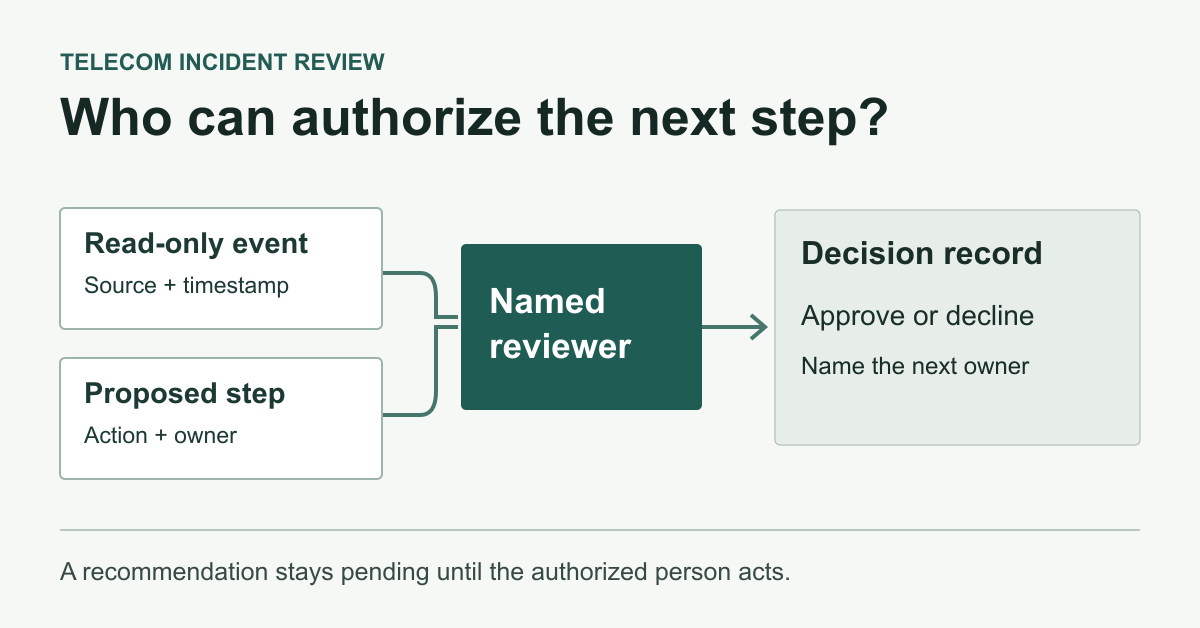
Use three columns on your scorecard: evidence (can the reviewer open the original event and see its time?), ownership (does the agent distinguish your assets from another party’s?), and authority (does a proposed action remain pending until the right person approves it?). Score each column 0 for missing, 1 for a documented capability and 2 for a demonstration on an agreed, de-identified case. Write down what earned the mark. A 2 for evidence cannot compensate for sending a customer notice without approval.
Ownership is especially easy to miss at an interconnection point. In his chapter on the physical Internet behind AI, Hunter Newby distinguishes a neutral facility from an exchange operating inside it. Apply that distinction to the incident record: who operates the building, who runs the exchange, and who supplies this circuit? The address on an alarm does not answer all three questions.
What would one investigation cost on your bill?
Ask each vendor to price the same month: the same number of incidents, investigation length, connected data sources, users and escalations. Get the fixed subscription, usage, integration, data retention and human review costs on separate lines. ServiceNow publishes package descriptions with custom pricing. For Nokia, specify the network domains and deployment model in the quote request. No comparable public per-incident price was established for either.
AWS lists investigation pricing at $0.0083 per agent-second. In a hypothetical month with 12 investigations using 150 billable agent-seconds each, the investigation charge would be 12 × 150 × $0.0083 = $14.94, before associated service charges such as log queries. That is not 150 seconds of wall-clock outage time or a forecast for a carrier. Salesforce lists a Flex Credits option at $500 per 100,000 credits and other billing models. Until you know the credits consumed per action and your underlying licenses, that figure does not price a resolved billing dispute.
What should a useful incident replay look like?
Give each vendor the same closed case, with names and identifiers removed. Include a 09:12 application alarm, a 09:14 customer report and a later cloud deployment record. Withhold the carrier’s restoration notice. Ask for three outputs: a timeline with source links, a list of facts still missing and a proposed handoff. No live change or customer message is needed for this exercise.
Suppose the agent links both timed events but declares that the carrier restored the circuit. It earns credit for the timeline, not the restoration claim. Have the service owner decline the proposed all-clear and request carrier confirmation instead. Now inspect what was recorded: the unconfirmed status, the reviewer’s decision and the person responsible for following up. Compare the minutes a reviewer spends reconstructing that trail. That is a buyer-measurable output; a polished paragraph is not.
Questions to settle before signing
Do we need one platform for both network and customer care?
Not necessarily. Choose the system responsible for each decision. A service desk can receive a network finding without giving the assurance tool permission to communicate with customers.
What if a vendor cannot connect to our carrier’s telemetry?
Ask it to identify that gap and assign a handoff. A documented blind spot is workable; a diagnosis that treats unavailable telemetry as healthy is not.
What should we request instead of an accuracy percentage?
Count supported claims, unsupported claims and correct abstentions on a shared set of cases. Keep the cases, expected evidence and scoring rules identical across vendors.
Who should approve a proposed change?
The person authorized for that action: a network change owner for infrastructure, a billing approver for a credit or a designated service lead for an external update. Test a refusal as well as an approval.
What belongs in the commercial proposal?
Request covered domains, connector work, environments, retention, usage meters, overage terms and implementation effort. Ask for an example invoice that uses your case volume rather than a vendor-selected workload.
Where should a team start if ownership is unclear?
Map one customer service from the facility to the access circuit and application, and write the responsible party beside each segment. The Newby Ventures interconnection research is a useful starting point for the physical relationships. Take that map into the demo and ask the agent where its evidence ends.
About the Author

Hunter Newby
Founder, Newby Ventures
Entrepreneur, investor, and interconnection pioneer. Co-founded Telx, conceived the carrier-neutral Meet-Me-Room, and led data center development across the U.S. Now investing in network-neutral infrastructure through Newby Ventures.
Read more about Hunter →