


What Is Internet Latency? How to Compare Network Delay

Hunter Newby
November 23, 2026
What is internet latency? It is the time a packet takes to travel between defined points. Round-trip time measures the trip out and back. Fiber distance sets part of the delay, and equipment and queues add to it. A useful latency claim names the endpoints, what was timed, and when.
If one carrier quotes 12 milliseconds and another quotes 20, ask what is on each side of the clock. One number could describe the trip between two carrier routers. The other could include the path from a branch to an application. The smaller number does not tell you which service will feel faster to the branch.
- What the stopwatch includes
- Why the fiber route matters
- A buyer's latency budget
- How to request comparable path evidence
- What peering and transit change
- Frequently asked questions
What the stopwatch includes
One-way packet delay starts at one endpoint and stops at the other. Those clocks need a common time reference. Round-trip time, or RTT, can be timed from the sending side, but the return path can differ from the outbound path. Dividing RTT by two is not a measurement of either direction.
The IETF's round-trip delay metric defines the packet and the timing boundaries. A browser's total request time is different: it can also include name resolution, connection setup, waits at the application, and delivery of the response. Know which clock you are looking at before comparing reports.
Average delay does not tell you how often packets arrive late. Jitter is commonly used to mean variation in delay; ask which variation statistic a provider reports. Loss means a packet or its reply was not observed within the method's agreed window. A latency percentile calculated only from successful replies can look acceptable while other attempts time out.
Why the fiber route matters more than the map's ruler
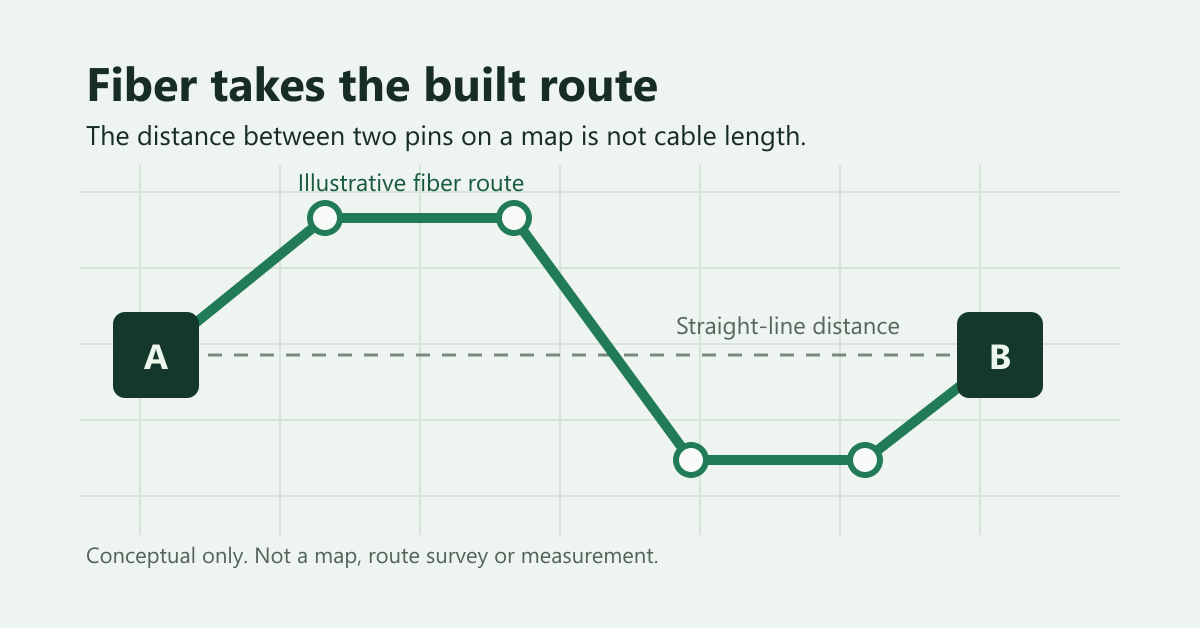
Fiber follows conduits, rights of way, and network handoffs. A path between buildings across town can run through an exchange or a carrier hub elsewhere before reaching its destination. Addresses that look close on a map do not establish cable length or route diversity.
Cisco illustrates a rough propagation estimate of five microseconds per kilometer of fiber. In an illustrative budget, 1,200 fiber kilometers each way contribute about 12 ms to round-trip time before any other delay: 2,400 km times 0.005 ms per km. The estimate is not a measured path, minimum guarantee, or quote.
Forwarding equipment takes time to process packets. A link also takes time to put the packet's bits onto the wire, and a packet may wait behind others in a queue. A higher link rate can reduce serialization time; it does not make light travel faster. A lower hop count is not proof of a shorter cable route.
Build a latency budget with separate lines for path and service
Give each number a boundary and a source. The example below is planning arithmetic for an imaginary path; the only derived line is the round-trip propagation estimate. The other values are assumptions, not normal operating bands.
| Component | Example | Evidence to request |
|---|---|---|
| Fiber propagation | 12 ms | Estimated route length in both directions. |
| Forwarding and serialization | 2 ms | The scope of the equipment and link estimate. |
| Queue allowance | 4 ms | Comparable observations at quiet and busy times. |
| Endpoint response | 2 ms | How the selected test endpoints respond. |
| Planned RTT | 20 ms | Check against a report using the same endpoints and method. |
Keep the application's processing and delivery budget outside this packet RTT unless the chosen test explicitly includes them. Likewise, don't add a network RTT twice because one column is called transport and another is called edge.
Ask providers for comparable path evidence
- Pick the question first. Separate branch-to-provider, provider-to-provider, and branch-to-application timing. Record the endpoints, direction and service path that matter.
- Match the method. Ask the teams responsible for the networks to specify packet type and size, the time window, sample count, address family, and timeout definition. Identify whether the report describes a quiet period or normal production load.
- Keep missed responses in view. Request the median, a named tail percentile such as p95, the sample count and loss alongside each comparison. The p95 reflects the slower end of the successful replies; it does not include missed replies unless the report says how it handled them.
- Separate changes from explanations. Compare reports taken on the same boundaries. If a result changes with load or direction, ask the provider what path or service conditions differed. A traceroute view alone does not establish circuit length, return-path performance, or physical diversity.
- Keep the acceptance record. Save the endpoints and method with the quote and name who will confirm the service against it. Ask how the service terms define the latency objective, where it applies and what happens if it is missed.
For example, if a branch sees slow application responses but the carrier's fixed-endpoint RTT stays within its agreed range, the tests are not contradictory. They timed different scopes. Keep the carrier result and ask the application team what the remaining time includes; do not assign fault from those two numbers alone.
What peering and transit change
Hunter Newby's explanation of interconnection shows what happens when networks can meet directly instead of relying on an intermediary. In a current procurement, the comparison is whether that arrangement changes paths to the destinations your users need, and what you would pay to use it.
Peering may replace a transit path for some destinations. It does not replace all transit or guarantee a faster return path. Compare the port, cross-connect, transport and operating terms against the routes and usage in question. For a compute-specific treatment of the same boundary problem, see Newby Ventures' analysis of inference latency beyond the chip.
Frequently asked questions
Are latency and bandwidth the same?
No. Bandwidth describes how much data a link can carry per unit time. Latency describes the time a packet takes to travel between specified points.
Does short geographic distance guarantee low latency?
No. The fiber can follow a longer route or cross several provider networks. Ask which route and endpoints the quoted result covers.
Can a good average hide a problem?
Yes. Delays near the slower end of the distribution and lost replies can matter to users even when the average of successful replies is low.
Is a ping a measure of application speed?
No. It measures a particular packet exchange between the selected endpoints. Application requests can take a different path or involve additional work before the user sees a response.
What belongs in a latency quote?
Look for named endpoints, direction or RTT, the measurement method, time window, statistic and treatment of loss. Compare terms and remedies only after those details match.
Does peering always cut latency?
No. It can change the path for some destinations. The useful comparison is measured on the relevant endpoints and approved paths, not inferred from the presence of an exchange.
About the Author

Hunter Newby
Founder, Newby Ventures
Entrepreneur, investor, and interconnection pioneer. Co-founded Telx, conceived the carrier-neutral Meet-Me-Room, and led data center development across the U.S. Now investing in network-neutral infrastructure through Newby Ventures.
Read more about Hunter →