


Data Center Services: What You Buy and Who Is Responsible

Hunter Newby
November 23, 2026
Data center services supply different parts of an IT deployment: space, power and cooling; physical connections; network transport or transit; on-site support; and, in some offers, managed servers or compute. Buyers should separate each service, its billing unit and its operating owner. One facility address does not establish one complete service contract.
Comparing data center services becomes easier when each proposal answers the same question: what will the supplier deliver, what must the customer do, and where does responsibility pass to another party? Start there before comparing headline prices or broad descriptions such as fully managed.
- Separate facility infrastructure, connectivity, physical support and managed operation.
- Ask for both service boundaries and commercial units.
- Make incident ownership and acceptance criteria explicit.
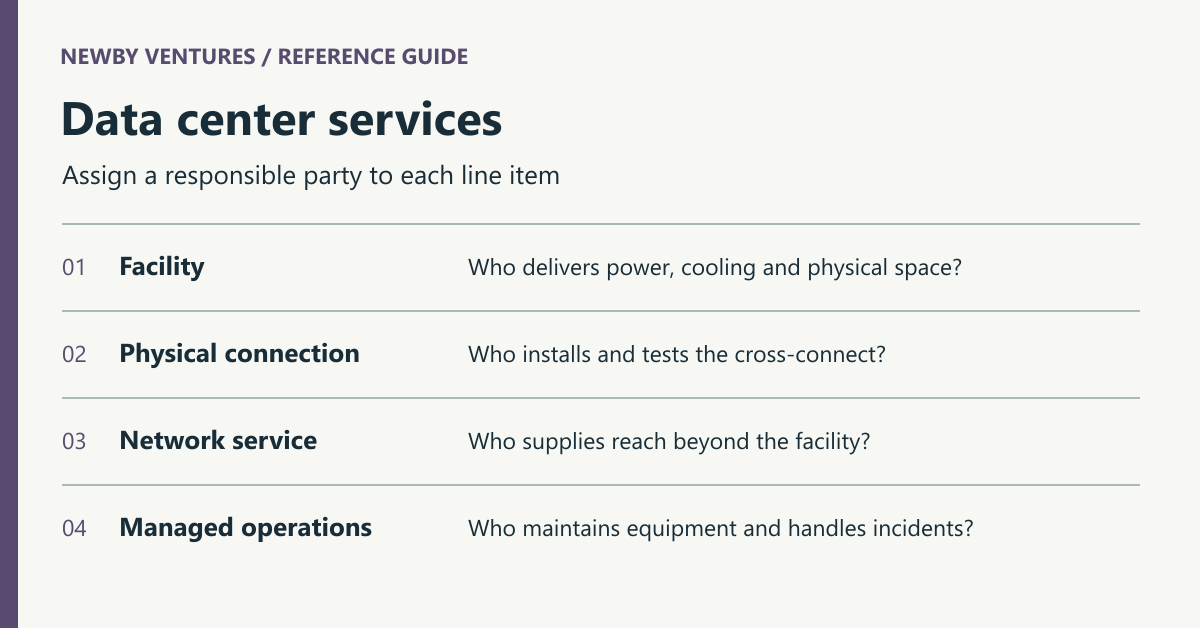
The main categories of data center services
Colocation generally places customer equipment in a provider's facility with contracted supporting infrastructure. Connections link equipment or networks. Physical support gives the customer access to on-site technical work. Managed services can shift specified operating responsibilities to a supplier, but the scope must be defined.
Equinix's operator documentation illustrates why these categories should be read separately. It is a useful example of service definitions, not a promise that every facility supplies the same products or terms. Confirm the current offer at the location being evaluated.
Build a responsibility worksheet
Use this original worksheet to compare data center services. Replace each generic category with the supplier's exact product name, add the billing unit, and mark included work, optional work and customer-owned work. Leave an item unresolved when the proposal does not answer it.
| Service category | What to define | Responsibility question |
|---|---|---|
| Space and facility infrastructure | Equipment footprint and contracted operating conditions | Who supplies, installs and maintains each component? |
| Physical interconnection | Connection endpoints and demarcation | Who orders, installs and tests each segment? |
| Network service | Transport, transit or other agreed reach | Who operates routing and resolves service faults? |
| On-site support | Permitted tasks, scheduling and authorization | Who gives instructions and confirms completion? |
| Managed compute or servers | Hardware, platform and administration scope | Who patches, monitors, secures and restores the system? |
| Application operation | Application, data and user-support responsibilities | Which work remains with the customer or another supplier? |
A cross-connect is not the complete network service
A physical link between two demarcations does not by itself define Internet reach, routing policy or the business agreement with the network at the other end. The connection and the service carried over it may be ordered and supported separately.
Hunter Newby's physical interconnection discussion is helpful context for those boundaries. For procurement, draw the path from the customer's equipment through each physical and service handoff. Record the responsible organization at every step.
When comparing data center services, request the current connection charges and the related network-service quote. Check the installation dependencies and renewal terms as well as the initial scope. Do not infer recurring cost or availability from an old example.
Remote hands and managed IT are different commitments
On-site assistance can include authorized physical work around equipment. It should not be assumed to include software administration, application monitoring or responsibility for a customer's overall service. Equinix's Smart Hands documentation is one provider example of a defined support offering.
For every requested task, clarify authorization, access, prerequisites, completion evidence and escalation. If a technician can replace a component, who determines that replacement is appropriate? Who supplies it, validates the application afterward, and maintains the software configuration? These are useful questions before an incident occurs.
Compare like-for-like commercial units
Two data center services proposals can look comparable while allocating different work to the customer. One may supply space for customer-owned hardware; another may include managed equipment. Ask what each billing unit measures and what assumptions sit behind the proposed quantity.
Create a cost schedule with separate lines for installation, recurring service, optional support and changes. Include contract length, cancellation conditions and the responsibility for dependencies. A complete comparison can use quoted amounts without pretending that a universal market price applies.
Also distinguish a service-level commitment from the customer's complete application objective. Request the covered component, measurement method, exclusions and remedy. A supplier's obligation for one service does not automatically extend to every external dependency.
A worked handoff example
Consider an illustrative customer installing its own servers and buying a network connection plus physical support. A connectivity problem could involve the customer's configuration, an installed connection or a network service. The example does not assume that any named provider has a fault.
Before launch, the parties should agree what each one tests, how findings are recorded and where the incident is escalated. A contact list alone is insufficient if no one owns the handoff. This exercise makes data center services more concrete than a list of product names.
Use the completed responsibility worksheet as a meeting document with the supplier. Resolve critical unknowns in the agreement and acceptance plan. Keep the dated version alongside the deployment records so later changes do not erase the original scope.
Frequently asked questions
Do data center services always include Internet access?
No. Confirm the contracted network service separately from the facility space and physical connection.
Is colocation the same as a managed server?
No. They can allocate hardware ownership and administration differently. Read the actual scope of each offer.
Does remote hands include application support?
Only when that work is expressly included. Do not treat a physical support offering as a complete application-management commitment.
What does fully managed mean?
It means only what the agreement defines. Ask for a responsibility list covering configuration, updates, monitoring, security, backup and recovery.
How should buyers compare data center services quotes?
Use the same deployment requirements, identify each billing unit and separate included, optional and customer-owned work.
What is the most useful document to request?
A clear scope and responsibility schedule, supported by service descriptions, applicable commitments, demarcations and an acceptance plan.
About the Author

Hunter Newby
Founder, Newby Ventures
Entrepreneur, investor, and interconnection pioneer. Co-founded Telx, conceived the carrier-neutral Meet-Me-Room, and led data center development across the U.S. Now investing in network-neutral infrastructure through Newby Ventures.
Read more about Hunter →