


What Is an Internet Exchange? Infrastructure, Participants and Peering

Hunter Newby
November 23, 2026
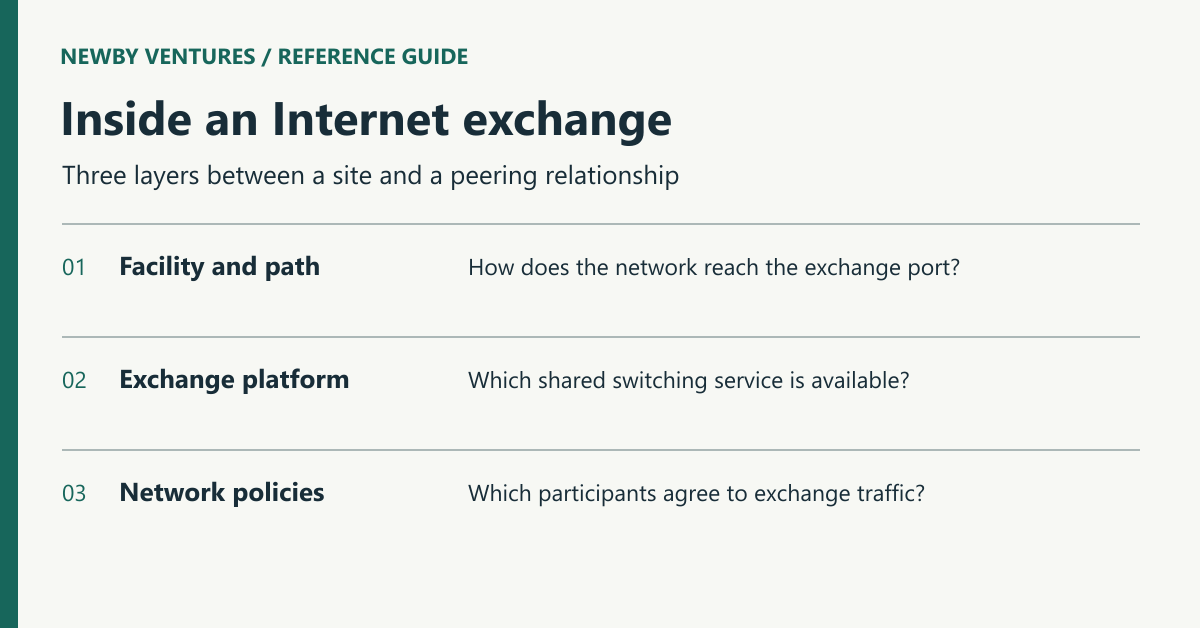
What is an Internet exchange? It is shared infrastructure that lets independent networks exchange Internet traffic directly. Participants connect to an exchange platform and establish the appropriate routing relationships. The building, exchange service and network agreements have different roles: buying a port does not guarantee that every desired network will exchange traffic with you.
The question what is an Internet exchange is easiest to answer by following one connection. A network needs a physical path to the platform, an appropriate service arrangement, and routing relationships that make the desired destinations reachable. Each part has an owner and a set of conditions.
- The physical site and the exchange service are related but distinct.
- Network participation and routing policy determine which traffic can be exchanged.
- Assess the actual local path and agreements before claiming a benefit.
What is an Internet exchange in everyday terms?
An exchange provides a place and platform where participating networks can interconnect. The Internet Society's IXP explainer describes both the technical infrastructure and the importance of cooperation among the organizations using it.
Consider an illustrative network serving users in one city and another network delivering content to those users. Direct local exchange may offer a useful alternative to a longer path through other networks. That is a reason to investigate the connection, not proof of a specific improvement. The actual routes, service conditions and measurements still matter.
Separate the facility, platform and participants
Hunter Newby's analysis of exchange and real-estate ownership makes the physical host and exchange operator explicit. He uses a real-estate lens to distinguish the supporting location from the exchange function. Broader industry usage may call the combined exchange infrastructure an IXP.
When answering what is an Internet exchange for a procurement team, identify these layers in ordinary language. This avoids a disagreement about acronyms while leaving the practical responsibilities clear.
| Layer | Role | Evidence to request |
|---|---|---|
| Facility and physical path | Hosts equipment and provides the connection route | Location, demarcation, access and cross-connect scope |
| Exchange platform | Provides the agreed exchange service | Service specification, port requirements and support process |
| Participating networks | Exchange routes and traffic according to their relationships | Current participation, policies and applicable agreements |
A port is the beginning of participation
A cable and a working port establish only part of the arrangement. Participants must meet the exchange's requirements and establish appropriate routing. Confirm the organization's technical identifiers, addressing, equipment, operating contacts and policy requirements with the relevant operator.
An autonomous system number identifies a network for inter-domain routing. Border Gateway Protocol is used to exchange routing information between autonomous systems. Network teams should apply the operator's current instructions and their own routing-security policies; a general article is not a substitute for a validated configuration.
The commercial answer to what is an Internet exchange must therefore include the participation conditions. An attractive list of connected organizations is useful research, but it does not establish that every listed network will exchange the routes a buyer needs.
Understand what a route server does
A route server can distribute routing information among participating peers, reducing the need to establish a separate routing session with every counterpart. It is a control-plane service; it should not be described as a transit router through which all exchanged data traffic must pass.
DE-CIX publishes route-server guides that illustrate the role of operator instructions and policy controls. Use the guide for the actual service being ordered. Participation in a route-server arrangement is not a promise that all possible destinations are reachable.
Use a connection-readiness checklist
This original checklist translates what is an Internet exchange into a practical pre-order discussion. Assign a responsible organization and a verification date to each answer. Keep missing evidence visible instead of filling the gaps with assumptions.
- Location: where will the network actually connect, and is access local or supplied through another service?
- Physical path: which connection segments and demarcations are included?
- Participation: which exchange and peer requirements apply?
- Routes: which destinations are needed and which agreements provide them?
- Security: who owns filtering, validation and ongoing policy changes?
- Support: who responds to port, path and routing incidents?
- Commercial scope: which installation, recurring and change charges remain?
Verify the benefit for the traffic you actually have
An exchange can create opportunities for more direct connectivity. Whether a particular organization benefits depends on the destinations, traffic pattern, available peers and alternative paths. Avoid transferring a result from another market to this deployment without a comparable test.
Record a baseline and agree what a successful change would look like. Use a representative set of destinations and conditions, then keep the before-and-after evidence. The useful answer to what is an Internet exchange is an explanation of the mechanism followed by evidence from the actual connection.
For further context, explore Newby Ventures' Internet exchange research. Treat listings as a starting point for verification, particularly when current service availability or a specific operating policy affects the purchase.
Frequently asked questions
What is an Internet exchange's main job?
It provides infrastructure through which participating networks can exchange traffic directly, subject to their technical and commercial arrangements.
Is the exchange the same thing as its building?
The building supplies a physical host; the exchange provides a service. They may share an owner, but their responsibilities should be identified separately.
Does buying a port guarantee access to every participant?
No. Current participation, routing policies and the applicable relationships determine which routes are exchanged.
What information should a first-time participant collect?
Collect the current service requirements, connection scope, network identifiers, operating contacts, routing policies and charges for the actual exchange.
Does a route server carry all exchanged traffic?
A route server distributes routing information. It should not be confused with a transit router carrying all participant data traffic.
Can a buyer assume a fixed latency saving?
No. Measure relevant paths under defined conditions. Location, routing, load and the actual service all affect the result.
About the Author

Hunter Newby
Founder, Newby Ventures
Entrepreneur, investor, and interconnection pioneer. Co-founded Telx, conceived the carrier-neutral Meet-Me-Room, and led data center development across the U.S. Now investing in network-neutral infrastructure through Newby Ventures.
Read more about Hunter →