


Chicago Colocation: Compare Carrier Access Before Rack Prices

Hunter Newby
November 23, 2026
Chicago colocation buyers should compare the carriers and exchanges they can reach from a specific rack before comparing rack prices. A carrier list for the Chicago metro is not a port order. Confirm the operator, facility, demarcation, path charges and power available for your deployment.
Even the site codes can confuse a quote. Equinix and CoreSite both use CH1, but for different addresses. Chicago Open Pipes uses its own location names. Put the full address and named handoff on the same line as the operator so a familiar code does not send you to the wrong building or port.
- Chicago addresses and handoffs
- Compare the full circuit
- Check capacity separately
- Build a Chicago shortlist
- Frequently asked questions
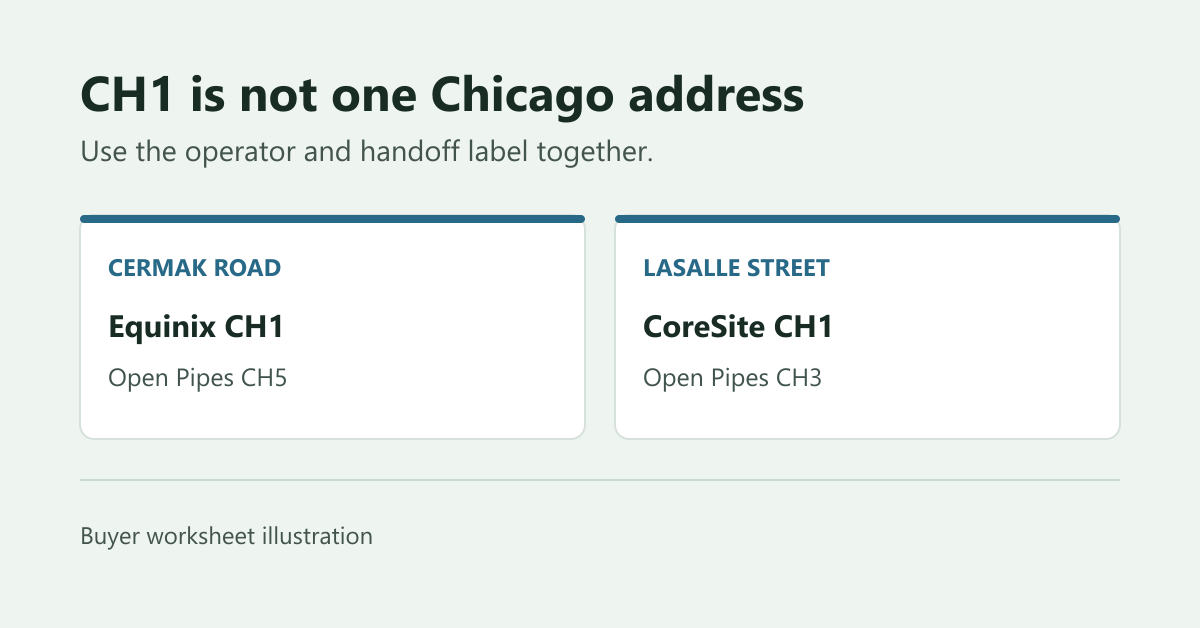
Start with the address and handoff, not the facility code
These are examples from first-party listings checked November 23, 2026. An advertised address or exchange location does not establish rack availability, a free port, or the path a carrier would provision for your order.
| Address | Public listing | Quote question |
|---|---|---|
| 350 E. Cermak Road | Equinix lists CH1 on the fifth floor. Chicago Open Pipes lists more than one location at the same street address. | Which room, floor and panel does this quote reach, and who supplies each cable segment? |
| 427 S. LaSalle Street | CoreSite calls this facility CH1. Chicago Open Pipes labels its access location there CH3. | Is the chosen handoff in the building meet-me room, and what is needed to reach it from the rack? |
| 800 W. Jorie Boulevard, Oak Brook | Chicago Open Pipes lists an NYI location under its own CH8 label. | Is this the site in my colocation order, or an exchange access point reached through separately quoted transport? |
Two quotes at different floors of 350 E. Cermak are not evidence of two buildings or two separate physical routes. Even two street addresses may share conduits or upstream segments. Ask each provider for the scope its claims cover and identify any route segment it cannot confirm.
Compare the full circuit from your rack
Ask the facility operator to identify the connecting point and the carrier to identify the service endpoint. If they describe different places, find out who buys the extra cable or transport. A carrier's presence at a building is not the same as an agreement to peer, or as service being available at your panel.
Put one-time installation, cross-connects, carrier or exchange charges, labor, and any offsite extension on separate quote lines. Add the service term, billing start, support responsibility and exit terms. The lower rack price is not necessarily the lower first-year commitment if an extra path has to be bought to reach the networks.
For the commercial and physical history of those connections, see Hunter Newby's Meet Me In series. It documents how interconnection locations developed; historical carrier lists or terms are not present-day order evidence.
Check capacity on a separate line
For colocation, ask which space and power are available for your equipment, when the provider can deliver them, and what cooling or installation conditions apply. An interconnection building can be a useful network hub without having the rack power or cooling schedule you need. If the compute is hosted somewhere else, quote the interconnection site and compute site separately, including the link between them.
Ask who runs the building, who operates the room, who sells the exchange port or carrier service, and who takes an incident. The contract may bundle those roles or split them across vendors. Consult the facility comparison worksheet for the general roles; use the Chicago addresses above to make the worksheet specific.
Build a shortlist that can survive an order review
- Write the networks, service type, facility requirements and target delivery date before asking for quotes.
- For each option, record the operator, address, room, carrier or exchange service, and the orderable handoff from the proposed rack.
- Request a current quote for all segments, and identify any shared paths and any capacity not yet committed.
- Compare costs only among options that meet the essential network and space requirements. Send unresolved items to the vendor that controls them.
For example, one quote may name Cermak but rely on transport to the chosen exchange port, while another may put the buyer in a facility with a direct handoff. Ask both for the complete order before crediting either for direct access. The missing transport line is a question, not a zero price.
Frequently asked questions
Is CH1 the same site on every Chicago listing?
No. Write the operator and street address with the code. The facility and exchange may each have their own naming system.
Does the carrier list prove I can order service?
No. Ask for the current service and exact demarcation from the parties that will deliver the connection.
Does a downtown address guarantee better latency?
No. The actual endpoints, fiber routes, and provider networks determine the path you are comparing.
Are two different providers at Cermak two separate sites?
Two providers at one address are not two buildings. Ask for the evidence that supports your actual diversity requirement.
Where should I start comparing prices?
Start with the proposed rack, the entire handoff path, and any commitments. Ask for both one-time and recurring costs.
Can a network hub also host an AI deployment?
It can, but confirm the specific power, cooling, availability and delivery terms. Do not infer compute capacity from interconnection access.
About the Author

Hunter Newby
Founder, Newby Ventures
Entrepreneur, investor, and interconnection pioneer. Co-founded Telx, conceived the carrier-neutral Meet-Me-Room, and led data center development across the U.S. Now investing in network-neutral infrastructure through Newby Ventures.
Read more about Hunter →