

AI Infrastructure Investment: What Can the First Tenant Actually Use?

Hunter Newby
November 25, 2026
AI infrastructure investment starts with a specific question: what can the first paying customer use, in which building, and on what date? Match the customer’s commitment to the space, power, cooling and network available in that phase. Land for expansion and a customer’s option to expand belong on a separate line from capacity either side has committed to deliver.
An investment memo might say the site can host eight halls and the prospective tenant wants eight halls. The numbers line up. The dates and obligations might not. If the tenant has signed for one hall, the utility has committed to one phase, and the tenant can walk away from the other seven, the relevant first decision is about one hall. The remaining land may have value without being leased, powered or ready for GPUs.
Define the first phase | Read the demand | Check four gates | Work a delivery example | Buyer questions
What exactly is the investment buying?
Start with the asset and counterparty, not the campus announcement. A parcel under option gives a developer a right to pursue the land under stated terms. A completed shell is a building. A fitted hall adds electrical and cooling systems. A managed compute contract adds equipment and an operating service. A tenant taking one of these is not necessarily buying the others. Mark who will pay for each element, who owns it afterward, and who must accept delivery.
Put the capital request in one sentence that a facilities lead and a finance lead would both recognize: “This payment buys this deliverable for this customer by this milestone.” If it buys equipment for more than one phase, show which part the first tenant needs and which part the owner is funding in anticipation of later demand. Without that split, it is easy to allocate all the expansion cost to tomorrow and all the anticipated revenue to today.
The International Energy Agency’s analysis of data-centre electricity demand describes how sites fill progressively and why actual peak use can be uncertain. That helps explain why a grid connection request and an operating load might look different. It does not establish demand for an individual facility. For the narrower question of what the utility has actually evaluated, see how to read a utility study.
Is demand an order, an option or a conversation?
Ask the commercial team to show how a tenant moves from an inquiry to a payment obligation. A prospect tour shows interest. A letter of intent can describe a proposed transaction; ask counsel which provisions, if any, bind the parties. An executed order can still depend on acceptance, delivery by a specified date or the customer’s right to terminate. Read the conditions alongside the headline quantity.
Then ask who is counting the demand. A broker, a developer and a GPU provider may each be discussing the same deployment. Counting their statements as three customers would multiply one opportunity without adding a second buyer. The commercial team can reconcile these records internally using a customer and phase identifier; the committee does not need personal contact details.
For each phase, keep four items together: the minimum commitment, optional quantities, the event that starts billing and the event that lets the customer cancel or resize. Put an unpriced option in the options column. Do not silently promote it to signed revenue, but do not dismiss it either: a tenant may value room to expand without being obliged to take it.
Four gates from a signed tenant to a usable hall
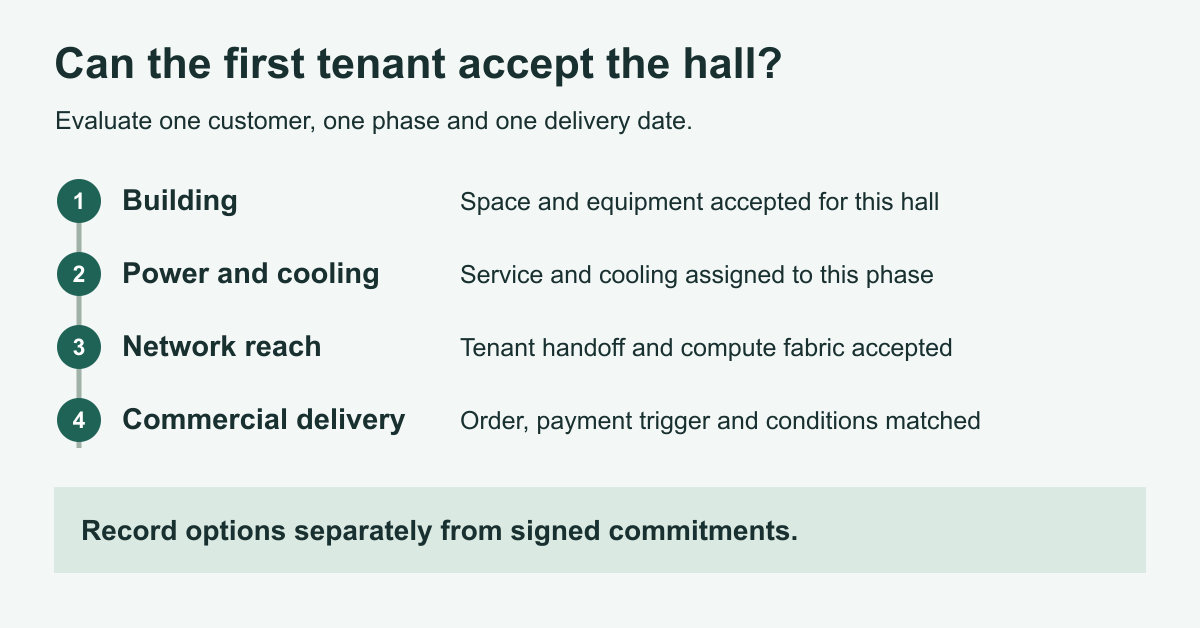
| Gate | Evidence for the first phase | Question still open |
|---|---|---|
| Building | Control of the space and the facility team’s approval for the actual equipment, floor loading and delivery path. | Does acceptance cover this hall and rack configuration or only the shell? |
| Power and cooling | Phase-specific utility service, power allocated to IT and the operator’s cooling acceptance for the intended load. | What remains to be installed, tested or allocated before the tenant can use it? |
| Network reach | A service order and handoff for the customer’s network, plus the platform team’s acceptance of the compute fabric. | Who accepts each path, and does the test represent the intended workload? |
| Commercial delivery | Executed tenant and supplier commitments, with quantities, deadlines, conditions and acceptance responsibilities. | Which payments start before the tenant is obliged to pay? |
| Committee record | For each gate, name the document, responsible party, open condition and next decision date. | Can capital be committed in steps while one dependency remains open? |
Network reach deserves two different questions. Inside a cluster, accelerators need to communicate with each other and access storage. NVIDIA’s B200 reference architecture distinguishes compute, storage and management networks. Outside the cluster, a user’s inference request must reach the application and the response must return. Queueing and model processing also take time. A fast compute-fabric specification is not a measurement of that user’s experience; distance to a population center is not one either.
Hunter Newby’s chapter on AI infrastructure and physical interconnection asks what changes when networks can meet locally. For a tenant, turn that perspective into a contract question: which networks can actually exchange the relevant traffic at the agreed handoff? A carrier appearing in a regional directory does not, by itself, give this tenant an installed service or a delivery date.
Worked example: three reservations, one paying customer
Suppose a developer presents three equal-sized suites. Suite A has an executed customer order, with billing after acceptance. The same customer has an option on Suite B. A different prospect has expressed interest in Suite C. For the first-phase decision, that is one contracted suite subject to acceptance, one option and one prospect. It is not three contracted suites, and it is not yet one billing suite.
Now suppose the building and commissioned cooling for A are available in September, the customer’s hardware is scheduled for October, and the ordered network service is due in November. If the contract requires all three before acceptance, September is not the first supportable billing month. November is the earliest candidate month in this illustration, not assured revenue. A subsequent customer test or acceptance notice could move it again. No forecast of costs, utilization or returns follows from these assumed dates.
The useful amendment to the memo is specific: keep the first-suite construction decision separate from hardware deposits for B and C. Show the deposit deadline alongside the still-open option exercise date. Ask the sponsor what happens to the deposit if the tenant declines. That gives the committee a fact it can negotiate, rather than a probability everyone has to guess.
Questions to settle before capital is committed
Does a land purchase establish usable capacity?
No. It establishes a property interest on its own terms. Identify what has been permitted, serviced, installed and accepted for the planned use. Keep the land case distinct from the operating-hall case.
Are total facility power and power available to IT the same?
No. Ask where each figure is measured, which phase it describes and what allocation the operator commits to the customer. Have the responsible facilities team confirm the intended configuration instead of applying a generic conversion.
What if the operator supplies the hall but the tenant buys the GPUs?
Separate the obligations. Record who orders and pays for hardware, confirms it fits, installs it and conducts acceptance. Check what the agreement says if the hall is ready while the equipment is not.
Can proximity to users prove low inference latency?
No. It is one consideration. Ask the application owner how it evaluates the journey from the user to a usable response under the intended workload. An internal cluster test answers a different question.
What makes a second-phase option useful evidence?
Its terms: when the tenant has to decide, what it must do to exercise, and what the owner must hold available in the meantime. Those details help price the choice without treating it as a signed expansion.
What belongs on the first page of the decision memo?
Show the first customer, first usable phase, acceptance requirement and largest payment due before that requirement is met. Attach the four-gate record. For more context on where the physical network fits into the decision, explore Hunter Newby’s interconnection research.
About the Author

Hunter Newby
Founder, Newby Ventures
Entrepreneur, investor, and interconnection pioneer. Co-founded Telx, conceived the carrier-neutral Meet-Me-Room, and led data center development across the U.S. Now investing in network-neutral infrastructure through Newby Ventures.
Read more about Hunter →