


Data Center Utility Power Study: What a Utility Letter Can Establish

Hunter Newby
November 25, 2026
A data center utility power study tells you which load a utility evaluated, at which delivery point, on what schedule and under which assumptions. It does not, by itself, put electricity at a rack. Before committing to a site, separate four dates: study completion, a binding service commitment, energization and usable capacity in the hall.
Suppose a seller offers “20 MW available.” The attachment describes a request for 20 MW at full buildout. Its first phase is 5 MW, contingent on upgrades, and the letter says nothing about the hall's cooling. Both documents can refer to the same project. Only one describes the capacity the seller wants you to buy. Put the phase, boundary and conditions next to the number before taking it to your investment committee.
Read the letter | Identify the study stage | Check four delivery gates | Work through a phased offer | Buyer questions
What did the utility actually agree to?
Start with the issuer, addressee, site identifier, delivery point and date. Is the customer asking the utility to study a load, or is the utility replying? A customer load letter can be evidence of the request. A utility feasibility response can be evidence of the utility's assessment. Neither document, just by its title, establishes that the parties have signed a particular construction or service agreement.
Highlight the verbs beside each milestone. “Requested,” “studied,” “estimated,” “contracted” and “energized” answer different questions. Copy any conditions onto the same line: required approvals, who pays for upgrades, when a deposit is due, whether the request expires and what causes a restudy. Ask the issuing utility or authorized customer representative to resolve the wording rather than treating a broker's summary as a substitute.
On its Virginia data center request page, Dominion Energy distinguishes preliminary evaluation from the site-specific power plan. It can provide a will-serve letter during site selection, and service typically ramps in stages. That is useful evidence about its process. It isn't a promise about a particular Virginia site or the meaning of another utility's letter.
Which part of the study process is finished?
Portland General Electric's large-load study process illustrates why the stage matters. A pre-feasibility review screens a request at a high level. A facilities study addresses the equipment and work required for upgrades and estimates costs. A schedule for completing a study is not the schedule for installing everything the study identifies. Ask which date appears in the proposal.
Dominion's May 2026 large-load report also describes how load ramps, engineering studies and construction arrangements fit together. Use the utility's own process for the site in question. A neighboring territory's timeline is not a substitute, and an agreement for one phase may say nothing about the next.
For each document, record the capacity units, the measurement boundary, the stage, the phase date and what must happen next. If an estimate says MVA and a sales sheet says MW, ask for the underlying operating assumptions and the utility-confirmed conversion. If an offer says MW, ask whether it is total facility input or power allocated to IT equipment.
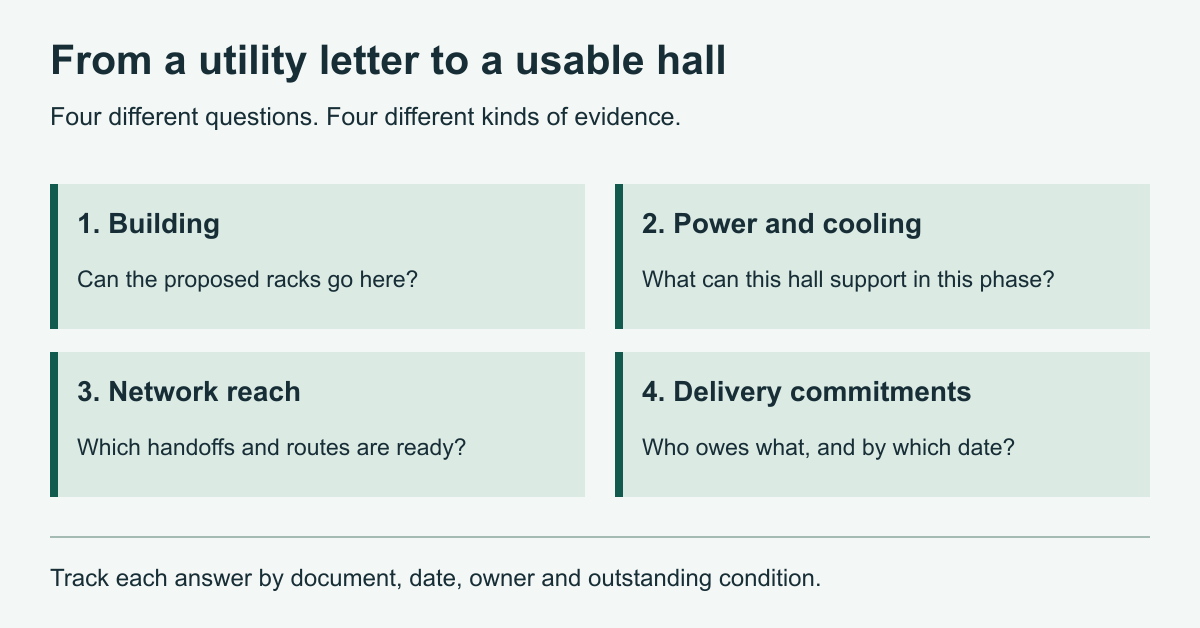
Four gates between a power request and a working AI deployment
| Gate | What to request | What remains separate |
|---|---|---|
| Building | Approved hall layout, equipment delivery path and the facility team's assessment of the proposed rack loads. | Floor area alone doesn't establish where heavy racks can be installed. |
| Power and cooling | Phase-specific utility input, commissioned hall capacity and cooling allocation at the proposed density. | A site-wide total or modeled expansion need not be available in this hall. |
| Network reach | Carrier handoff, delivery date, route dependencies and a workload-specific acceptance plan. | A campus fiber listing does not establish the path to users or the fabric between GPUs. |
| Commercial delivery | Executed scope for that phase, milestone owner, dependencies, payment dates and delivery remedies. | Utility energization does not mean the tenant can occupy or use the space. |
| Decision record | For each gate, log the document, issuer, date, open condition and person who can close it. | Do not average four answers into a score that hides one missing dependency. |
For an AI deployment, be precise about which network must perform. Communication between accelerators inside a cluster uses the local fabric. A request reaching the facility from another city also crosses a wide-area path and spends time in queues and processing. A utility study measures neither. Hunter Newby's chapter on physical infrastructure supporting AI is useful context for why network location belongs in the same buying decision as power, even though it needs its own evidence.
What would you do with a 20 MW headline and a 5 MW first phase?
In this hypothetical offer, Phase 1 provides 5 MW of total facility input after the stated conditions are met. Suppose the operating plan assumes a power usage effectiveness (PUE) of 1.25 under the relevant conditions. PUE compares total facility energy with IT energy over the same period and boundary. Applying it as a planning assumption gives 5 ÷ 1.25 = 4 MW of indicative IT load at comparable operation. It is not a measured rack allocation, an instantaneous design limit or a service guarantee. Ask the facility team for the actual commissioned power and cooling allocation.
If the first deployment needs 4.5 MW of IT load, the indicative gap is 0.5 MW. Don't use the 20 MW ultimate request to close a Phase 1 gap on paper. Ask if a smaller first deployment is viable, whether a later phase has a binding delivery milestone, or whether the facility can support a different allocation with documented capacity. Compare each option against the workload's actual start date and the costs of delayed equipment.
A useful decision note fits in one sentence: “The utility evaluated the ultimate request; the first phase is conditional; the proposed IT allocation and commissioning date are still to be confirmed by the facility.” Replace each part as evidence arrives. That gives procurement something more useful than either “power available” or a blanket rejection.
Questions to take back to the utility and facility
Is a will-serve letter the same as a reservation?
Not necessarily. Read its terms and ask the issuer what it commits to for this customer, location, phase and date. Identify the separate document, payment or milestone needed to secure service where applicable.
Does a utility study include the cooling plant?
It may include projected cooling demand in the requested load. That is different from evidence that the cooling plant has been installed, commissioned and allocated to the proposed hall.
Does a place in a planning forecast prove that power exists today?
No. Forecasting future demand and delivering service are different activities. Ask for the status of the physical work and for confirmation of energization at the promised delivery point.
Can two sites with the same megawatt offer support different deployments?
Yes. One offer may describe ultimate utility input and another commissioned IT capacity. Compare the same boundary, phase, cooling conditions and contract date before comparing prices.
What should a finance team ask about upgrades?
Who funds each item, when the obligation arises and what happens if scope or timing changes. Separate an estimate, a deposit, a nonrefundable commitment and a recurring service charge. Use the actual agreements for the project.
What is the best next step when the documents disagree?
Send the utility and the facility operator a short reconciliation: the two numbers, their respective boundaries, the proposed date and the decision that depends on them. Ask each party to confirm only the part it controls. Keep the difference open until their answers describe the same phase.
About the Author

Hunter Newby
Founder, Newby Ventures
Entrepreneur, investor, and interconnection pioneer. Co-founded Telx, conceived the carrier-neutral Meet-Me-Room, and led data center development across the U.S. Now investing in network-neutral infrastructure through Newby Ventures.
Read more about Hunter →