


Data Center Interconnect Options: A Decision Guide for Network Buyers

Hunter Newby
November 24, 2026
A data center interconnect links equipment in two or more facilities. To compare offers, start by naming the two handoffs and the workload that must cross them. A fiber pair, a managed wavelength and an Ethernet circuit can connect the same buildings while leaving different equipment, costs and outage responsibilities with the buyer.
Suppose your storage team asks for a faster link between its primary and recovery sites. What does “faster” mean? A larger port might finish a nightly copy sooner. It may do little for an application that waits for a reply before sending the next request. Put the completion window and the round-trip requirement on separate lines of the order.
Define the handoffs | Compare the service options | Build a latency budget | Set the acceptance test | Buyer questions
Where does the provider's responsibility begin and end?
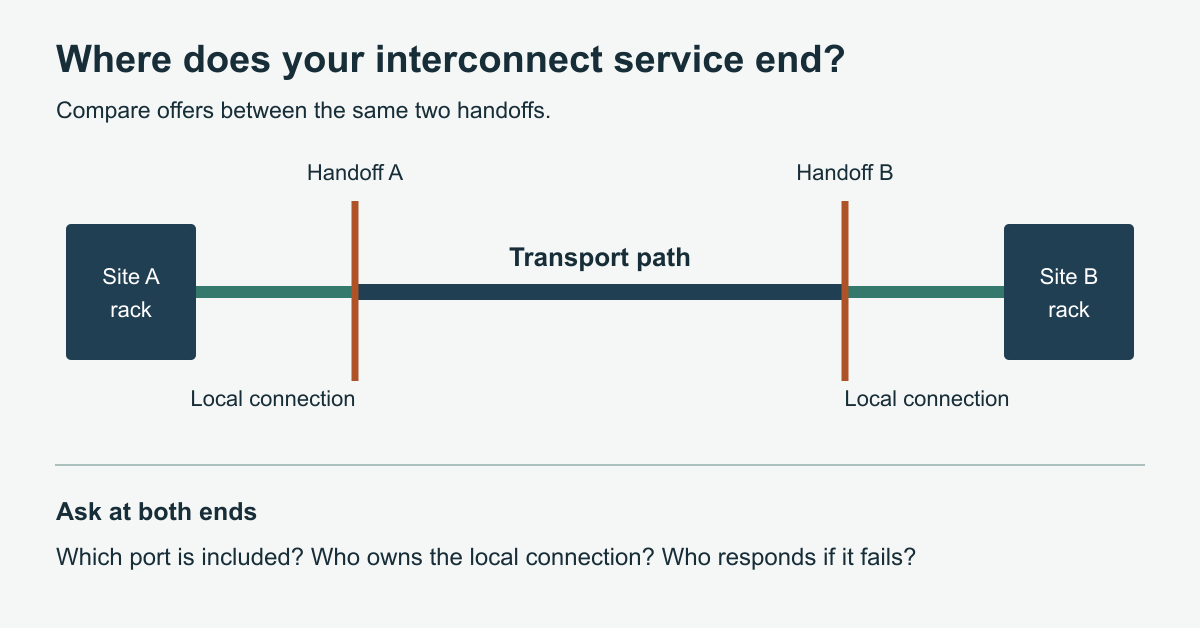
Write down a physical endpoint at each site: the room or cabinet, the port, the interface type and who delivers the connection to your equipment. “Building A to building B” may mean meet-me room to meet-me room. The cross-connect from each room to your cage can require a separate order, fee and installation date. Your request should show both of those local segments even if the transport provider doesn't supply them.
In his chapter on physical interconnection fundamentals, Hunter Newby explains why a network relationship ultimately depends on a physical place to connect. For a buyer, that translates into a practical question: if light reaches the building but not your rack, whose ticket stays open? Ask the facility, carrier and your own operations team to name one owner for each segment before comparing delivery dates.
Which data center interconnect service are you actually buying?
Dark fiber: You lease access to unlit strands and arrange the equipment that lights them. Ask who supplies and maintains terminal equipment, who repairs the outside plant, and what test results are delivered at handoff. Control over optics can be useful, but operating them and keeping spares are part of the cost. The fiber lease alone is not the full price of an operating service.
Managed wavelength: The provider supplies an optical transport service. Ask for the client interface, the two demarcation points and the protection option in the quote. A protected service and a separate, independently routed second circuit are different purchases. Ask what happens to the route and delay when protection switches; don't infer either from the word “protected.”
Carrier Ethernet: You buy an Ethernet handoff under a service definition. Ask about committed bandwidth, frame-size limits, traffic classes and the points between which the service promise applies. An interface marked 100 Gb/s does not by itself promise 100 Gb/s of committed delivery. An operator can carry Ethernet over optical transport, so “Ethernet” and “wavelength” describe different parts of a design. The deciding question is which layer the provider hands you and supports.
Separate private transport from Internet reachability. Peering exchanges agreed traffic with another network; transit buys broader IP reachability. Neither is automatically a private path between two racks. If a bid uses a routed service, ask which endpoints, routing responsibilities and service boundaries it includes. Compare installation, cross-connects at both buildings, monthly service, equipment and support over the same contract term.
How much round-trip time is left for the equipment?
Start with the route length, not the distance between city centers. For a pencil-and-paper example, assume light travels roughly 200,000 kilometers per second in fiber, or about 0.005 milliseconds per kilometer one way. A 120-kilometer route in each direction gives 240 × 0.005 = 1.20 ms of propagation for the round trip. The return route does not have to match the outbound route. Add the actual lengths separately when you know them.
| Budget line | Example input | What to verify |
|---|---|---|
| Workload ceiling | 4.00 ms network RTT | Which endpoints and percentile the application owner accepts. |
| Outbound propagation | 120 km × 0.005 = 0.60 ms | Actual forward fiber route, including detours. |
| Return propagation | 120 km × 0.005 = 0.60 ms | Whether the return uses the same length. |
| Remaining allowance | 4.00 − 1.20 = 2.80 ms | Processing, serialization, queueing and other network delay in both directions. |
| Alternate path | 180 km each way: 1.80 ms propagation | Only 2.20 ms remains under the same ceiling before other network delay. |
These are assumptions for comparing offers, not field measurements or a recommended limit. If a request spends another 3 ms on storage or application processing, that time belongs in the transaction budget. Don't add it to a measured network RTT and then also count it in the application's response time. And don't add the 99th percentile of each component and call the result the 99th percentile of the whole transaction: measure the complete transaction when that is the requirement.
How do you agree on an acceptance test before ordering?
- Name the endpoints and the owner of each test. Have the two site operators agree on the ports, direction, packet or frame size, traffic class, authorized load, time zone and maintenance window. Specify whether you are testing carrier handoff to handoff or application host to application host. A passing result at the carrier ports does not cover the local paths you excluded.
- Separate the quiet baseline from the busy interval. Request measurements on the agreed endpoints at low load and at a representative, mutually approved load. Record the number of samples, duration, median and high-percentile RTT, and missing replies. A single fastest reply makes a poor acceptance record. Never load a production path or induce a failover without the responsible operators' agreement.
- Define jitter and loss in the contract's terms. Different tools use “jitter” for different calculations. RFC 3393 defines a packet delay variation metric using differences in one-way delay. That is not the same as the spread of round-trip ping times. Agree how endpoints are timed and which packets count. Record loss separately; a missing reply is not a fast sample.
- Test the alternative you are paying for. Ask for the primary and backup route drawings at a level the provider can disclose. Mark shared entrances, risers, ducts and intermediate facilities. Fewer visible IP hops do not prove shorter fiber, and two circuit IDs do not establish two physical routes. In an agreed maintenance window, have the operators document the actual path or protection state, service interruption and post-switch behavior.
- Keep one comparable record for each offer. Retain endpoint labels, timestamp, traffic conditions, sample summary, route state, unresolved local segments and the person responsible for remediation. Compare results only when those fields line up. If they don't, request the missing evidence instead of declaring one carrier faster.
Questions buyers ask before signing
Does more bandwidth reduce latency?
It can reduce the time to put a frame onto a link and may reduce queueing under load. It does not make light travel a shorter distance. Ask whether the complaint is a slow bulk transfer, intermittent delay or a long request-and-reply cycle.
Do we need dark fiber to get a dedicated connection?
No. A managed service can offer dedicated capacity under its terms without putting you in charge of the optical equipment. Specify the capacity and isolation you require, then compare what each offer actually delivers.
Is a metro link always short enough for synchronous replication?
No. “Metro” is a geography label, not an application limit. Obtain the workload requirement from its owner or vendor and test the complete intended path, including its backup state.
Will two carriers guarantee route diversity?
No. Two providers can lease the same underlying fiber or use the same building entrance. Request evidence of independent failure points and record disclosed exceptions. A carrier name is not a route drawing.
What does a service credit tell us?
It describes a contractual remedy if the specified conditions are met. It doesn't measure the cost of an outage to your business. Check the reporting window, exclusions and measurement points separately from your own recovery plan.
What's the most useful first question for a facility tour?
“Show me where this service stops and who takes it from there.” Use the answer to trace the connection to both racks. The Newby research chapters offer more background on the buildings and network relationships behind that walk.
About the Author

Hunter Newby
Founder, Newby Ventures
Entrepreneur, investor, and interconnection pioneer. Co-founded Telx, conceived the carrier-neutral Meet-Me-Room, and led data center development across the U.S. Now investing in network-neutral infrastructure through Newby Ventures.
Read more about Hunter →