


The Big Apps: Evolution of the Meet Me Series (Series Introduction + New York)

Hunter Newby
February 1, 2005
Originally published in FATPIPE magazine, February 2005.
Part of a series of articles published in FATPIPE magazine from 2003-2005 examining carrier interconnection options in major North American cities. This article was published in the February 2005 issue. To download the complete series as one consolidated PDF (2.7 MB), click here.
Editor’s note: As the interconnection business evolves so to does the "Meet Me" series. Throughout 2004, we used this space to identify the key physical layer carrier interconnection points within the major North American markets. This year the series moves forward to identifying the key service providers with wholesale enterprise-focused offerings within those markets.
Clearly, the key services in the greatest demand by enterprise users today are Ethernet transport, both metro and long haul, and voice over Internet protocol (VolP). And since most enterprises deploying VolP only want to do so over a private native layer network, it's enterprise VolP demand that's driving Ethernet transport demand.
So, each month, the series will focus on the previously featured carrier hotels and their carrier customer bases. A list of standard questions will be presented to the known Ethernet transport and VolP service providers separately within each facility. The primary objective is to identify which carriers are offering Ethernet transport for enterprise wide area networks and which VolP carriers enterprise networks can directly connect to at each carrier hotel in order to maximize savings.
Going back to where it all began - old New York. If there are any doubts about the success of Ethernet transport and VolP, the "city that never sleeps" can put them to rest. One look at the staggering growth curve of Ethernet ports wired and connected in 60 Hudson Street's largest physical layer interconnection facility, tel*, is proof enough.
Being the central point of layer 1 interconnection in one of the world's largest carrier hotels gives a certain perspective that many other core interconnection facilities haven't yet seen. The trends in ordering at tely New York are a solid indication of what's to come for network service providers throughout the rest of North America. Observing these trends creates an advantage. Applying the knowledge creates revenue.
In the past 12 months, for example, category 5 Ethernet port deployment by network service providers to the tely meet me area has jumped 200 percent, double the increase of fiber and coax and three times the growth of DS-1/E-1. The vast majority of those ports are coming from native layer 2 metro, domestic and international long haul Ethernet transport providers, as well as direct physical network extensions from VolP carrier switches and gateways.
There are many international VolP carriers that use the public Internet for backhaul to the far end for call termination. There are
others that use the Internet to interconnect to other wholesale carriers and customer switches. These practices will continue, but
there also is a new dynamic beginning to take shape. Interconnection complexity is becoming less of an issue for the carriers at the carrier hotels because their network elements are in a common space with close interconnection proximity. What's more, there is a tremendous amount of Ethernet transport available between these key sites, which house a large section of the known carrier world. Having this access to a carrier marketplace enables service providers to create new services and features that get them to market in ways and at prices never before attainable over private layer 2 networks.
Indeed, having a good resource for potential local and long haul Ethernet partners in key markets can help out-of-region providers get circuits competed quickly and cost effectively. Aside from knowing which carriers are accessible, it is also important to know something about the type of service provided. Similarly, knowing the major VolP service providers in these markets, what they offer and how it is delivered can assist some service providers in complementing an existing product set or creating an entirely new one based on customers needs.
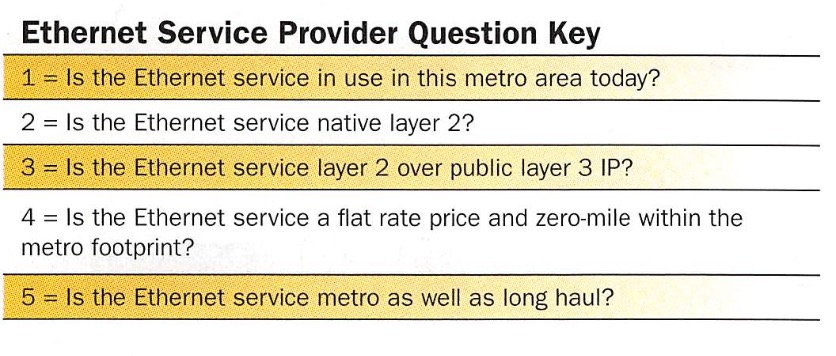
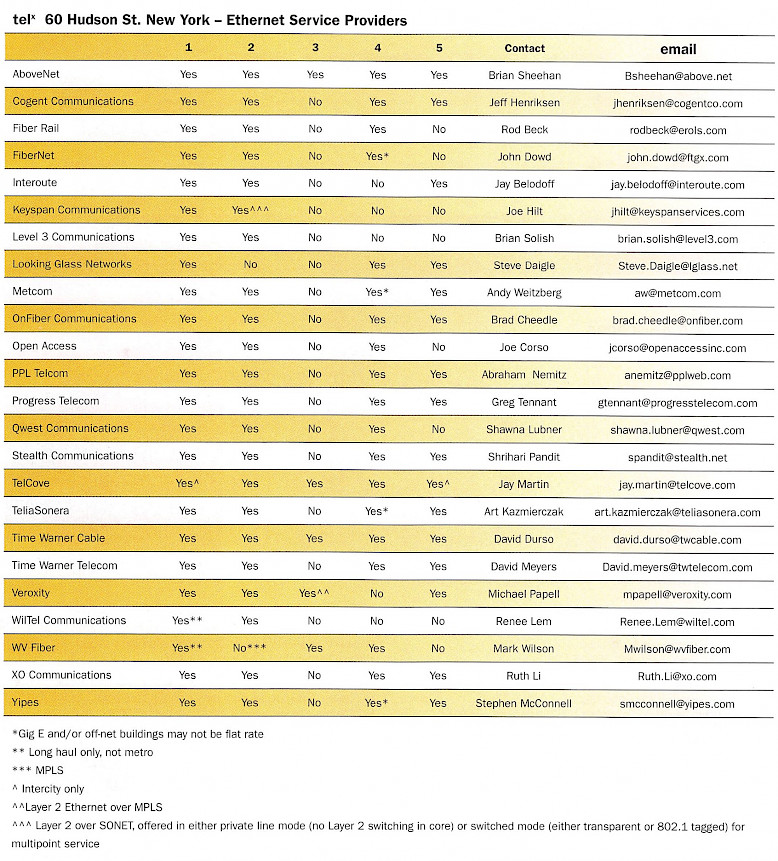
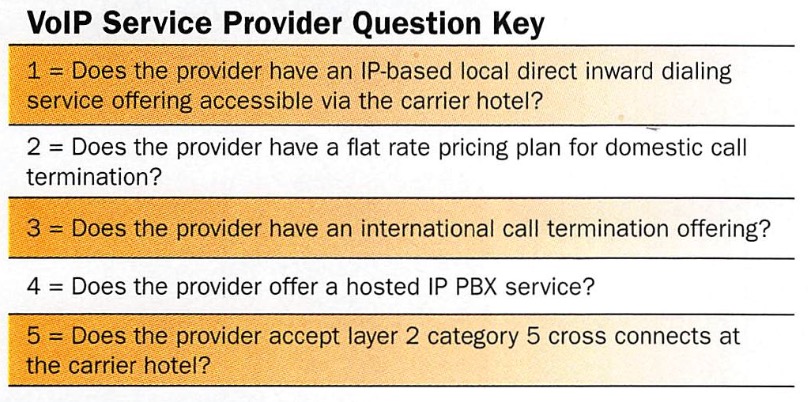
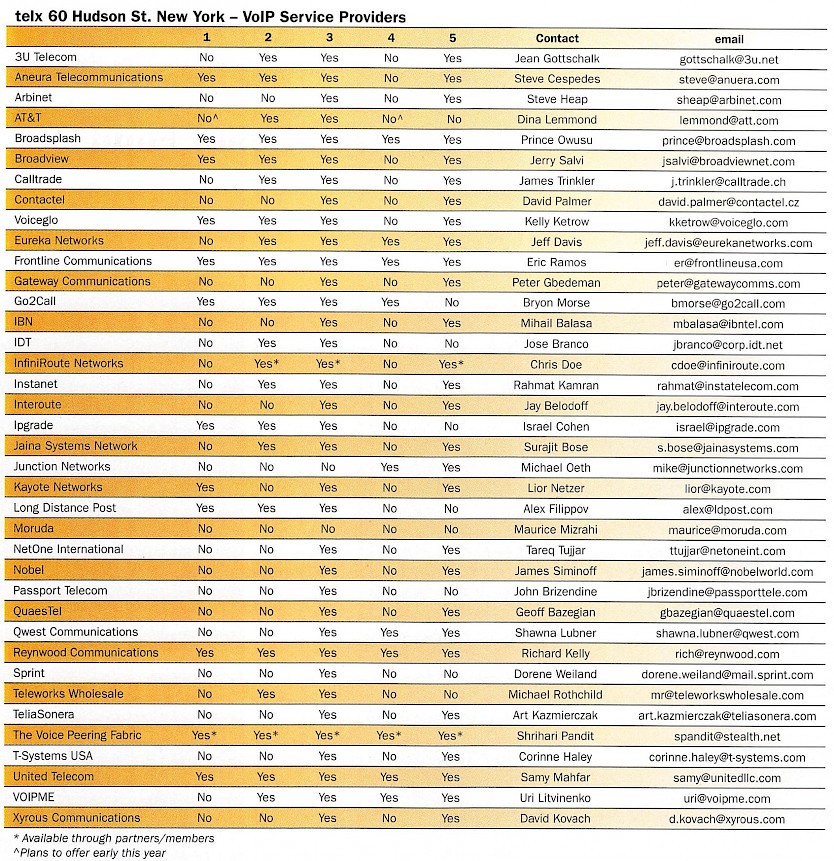
Here is a look at what is available at the tel facility today from these two key groups of service providers. The service providers listed below represent those that responded to the inquiry. As can be expected, a few replied that they do not offer the services being featured, and others chose not to participate.
Ethernet Service Providers
As it is with most of the industry, there simply are too many definitions and service types, which is one of the reasons for this new series. Many of the responses indicated that the Ethernet service was native layer 2, but after further inquiry it has been determined that this may also include Ethernet over SONET, not exactly native Ethernet. The point is to differentiate between those that operate and offer for sale a private, non-public IP transport service and those that offer Ethernet over the Internet, as this,
again, is at the center of the issue about voice over the public Internet verses VolP on a private layer 2 network.
VolP Service Providers
The responses from this group were quite interesting, as the questions and the audience was not limited to the international wholesale minutes aspect of VolP. Although the major carrier hotels are home to most of the large wholesale minute Volp service providers, there is clearly a new breed of hosted VolP applications coming up in these facilities.
One such application that has been developed into a service is the hosted Asterisk platform. This popular open source IP PBX is now being used to create a new service model that provides direct inward dialing over IP and free inter-company calling across the platform.
Also worth noting is the number of service providers that accept Ethernet connections at the interconnection facility. This puts into perspective the concept that metro and long haul Ethernet transport providers are using the interconnection facility as a destination for their customers. At that point the customers then interconnect to other outsourced, hosted VolP platforms for low cost, multifunction services, which allow them access to off-net voice termination at wholesale rates.
About the Author

Hunter Newby
Founder, Newby Ventures
Entrepreneur, investor, and interconnection pioneer. Co-founded Telx, conceived the carrier-neutral Meet-Me-Room, and led data center development across the U.S. Now investing in network-neutral infrastructure through Newby Ventures.
Read more about Hunter →