


Meet Me in Miami

Hunter Newby
November 1, 2003
Originally published in FATPIPE magazine, November 2003.
Part of a series of articles published in FATPIPE magazine from 2003-2005 examining carrier interconnection options in major North American cities. This article was published in the November 2003 issue. To download the complete series as one consolidated PDF (2.7 MB), click here.
Miami is a hot place to be and not just because of its average daily temperatures, spicy foods or rich cultural mixes. It’s also a hot spot for core network access. The market is one of the best examples of what facilities a gateway city normally possesses, and that helps to clarify the difference between a core interconnection facility and a data center or hosting facility. The state of Florida, having such an extensive coastline, with proximity to Caribbean islands and all of Central and Latin America, has natural advantages as a landing spot for many undersea cables. These cables come ashore all over the coast, but most of them backhaul to Miami. Miami is not just a city in Florida but also the key gateway to the Caribbean and Latin America.
Interestingly, Miami got a late start to the massive telecom infrastructure build-out game, since many of the undersea cables were not constructed when the insanity began. This pause created an opportunity for a world-class facility to be constructed from the ground up, literally sparing no expense. But, as you will see, the best money can buy in terms of a physical site does not always equate to the point of greatest multi-network access. Being “first to market,” whether accidentally or not, sometimes means everything. “Better,” as Dagda Mor says, “to be lucky rather than smart.” As is the case in any site selection, new entrants must go to where the fiber already is.
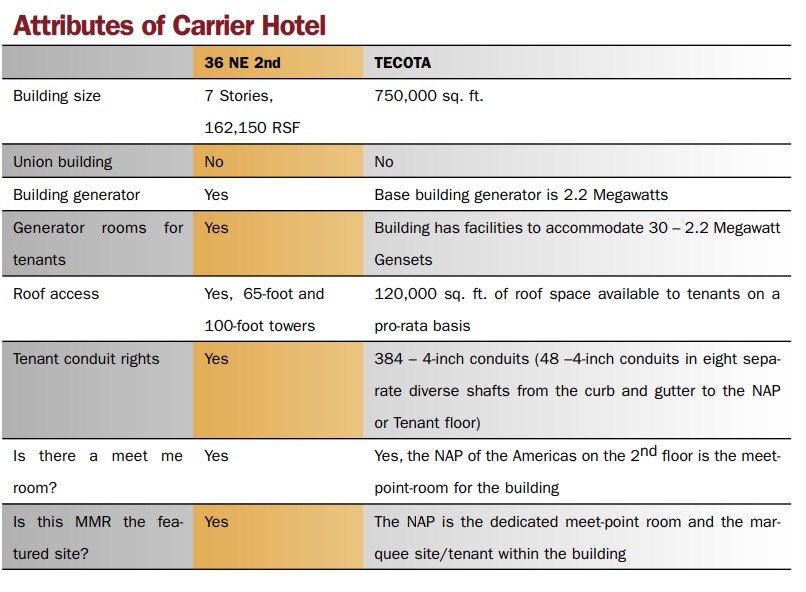
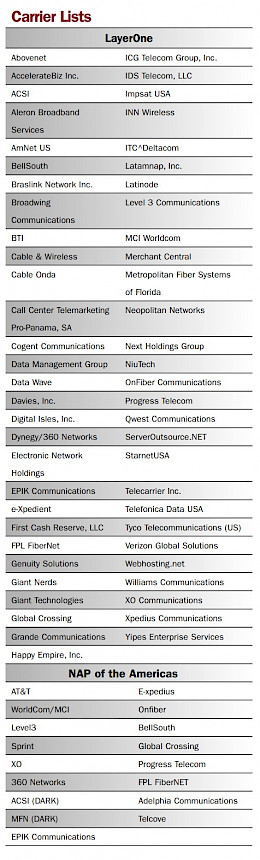
For all that Miami has to offer, there are two locations with mature interconnection facilities that usually come up in discussions. They are the LayerOne facility at 36 Northeast 2nd St. and the NAP of the Americas at the Technology Center of the Americas (TECOTA). Aside from these two well-known interconnection facility operators, there are a few other carrier hotel buildings, such as 100 North Biscayne, and other sites in Miami with a dense multinetwork presence.
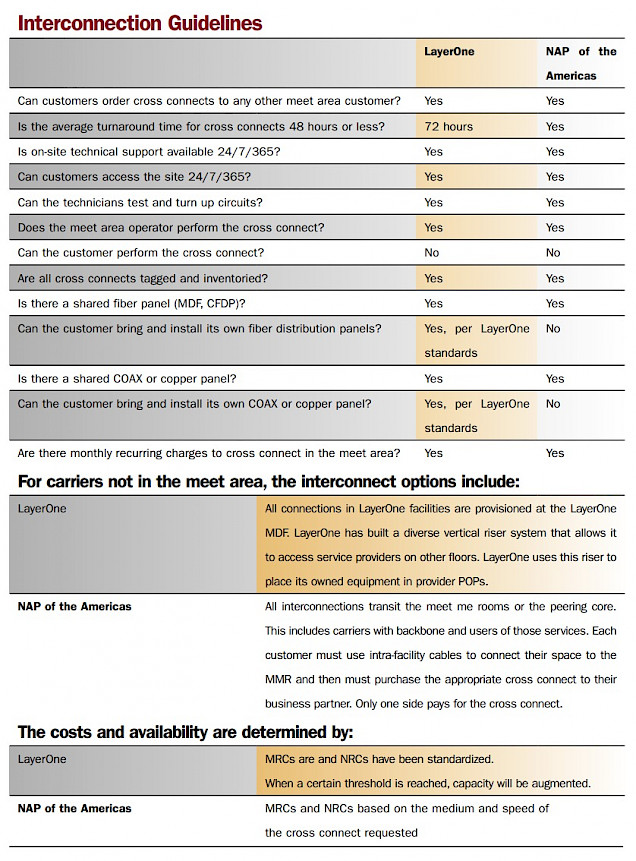
The “right” choice isn’t about which is the better building or site, in a mechanical sense. It really depends on what an incoming network operator needs. If you need a data center, you go to one. If you need a cabinet and two connections, you can go almost anywhere, but the key difference between a building with a meet point of some kind and one without is the ease of interconnection and the maximization of a single interconnect point. As always, this reduces the need for multiple home run cables and demarcation points, which create inventory and points of failure issues.
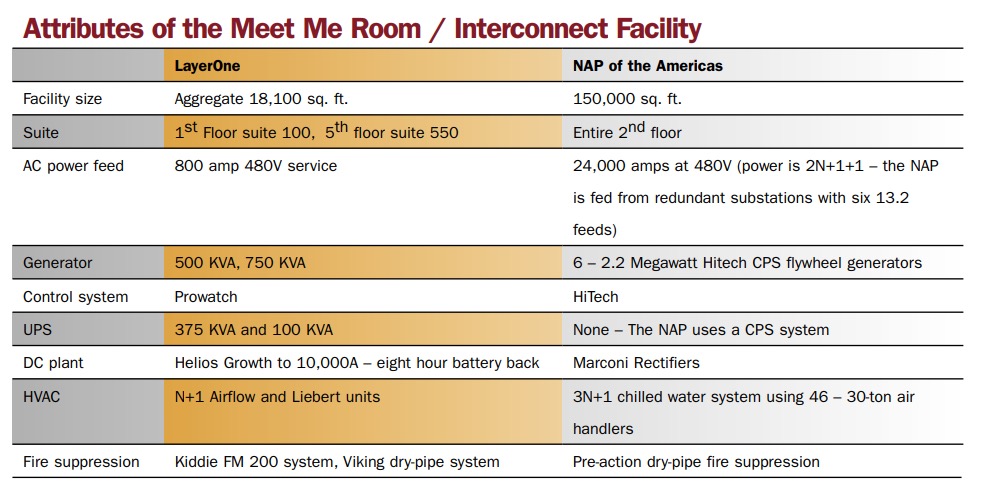
There is a great deal that can be said about both LayerOne and the NAP. The history of the NAP and the type of facility in terms of construction could take up pages, but what is particularly interesting about the NAP is that it is a core interconnection facility for major transport networks and a major Internet network access point. This is the only site in the entire “Meet Me” series that is both in one. That says a lot about it, as well as the clear difference between all of the other major core sites in North America and the Internet MAEs (metropolitan area exchanges), NAPs and sites such as Equinix and PAIX. The core interconnection points of the major transport and legacy time division multipex voice networks are not the same as the core Internet points. The fact that the NAP is both ties back into the fact that Miami got a late start, and they were able to plan the convergence.
LayerOne provides a highly dense point of interconnection for the market. It does not manage as much physical space as the NAP, but if you do not require a large footprint, this is a good location to explore. In either case, these are a couple of the best sites around in the Miami market.
For more information on NAP of the Americas, Inc. (a Terremark Worldwide company), contact Joshua Snow Horn, director, at (305) 808-5214 or [email protected].
For more information on LayerOne, call (214) 752-6204 or check out www.layerone.com.
About the Author

Hunter Newby
Founder, Newby Ventures
Entrepreneur, investor, and interconnection pioneer. Co-founded Telx, conceived the carrier-neutral Meet-Me-Room, and led data center development across the U.S. Now investing in network-neutral infrastructure through Newby Ventures.
Read more about Hunter →