

A New Microwave Backhaul Network Philosophy

Hunter Newby
December 1, 2010
Originally published in Above Ground Level Magazine, December 2010.
Introduction (by Richard P. Biby, P.E.)
A multiduct fiber-optic cable system delivers fiber to the tower for many wireless telecommunications sites and facilitates microwave backhaul for thousands of others.
Sometimes things just make sense.
A few facts: Backhaul has traditionally been the Achilles heel of the industry. Backhaul requirements have gone from a few T1 lines (each at about 1.544 Mbps) to a minimum of 20 Mbps to 100 Mbps. A major distinction involves the kind of service being delivered; that is, 1.544 Mpbs T1 = 24 voice channels, or DS0, also known as a plain old telephone service (POTS) line, and the pure Internet Protocol that 4G technologies (and honestly, most 3G) are looking to have delivered. The end result is that the world is going IP, if it has not already.
So, from say, a few T1 lines with 5 Mbps to 20 Mbps and with 100 Mbps minimums being designed for newer 4G deployments, the backhaul business is clearly going to be a winner. What market does not have at least one 4G provider planning or already building a network?
Improving backhaul
How do you advance to non-T1-based backhaul? How do you obtain a lot more of it? How do you make it affordable? Good questions! You can start by obtaining more T1 lines from an incumbent or competitive local exchange carrier (ILEC or CLEC). For $250 to $800 per T1, you receive T1 service along with some variables, hassle, and often no clear business or management path to success. You might instead prefer that a company such as Comcast, Verizon or AT&T would have a good reason to extend fiber-optic cable (fiber, for short) service to your cell site.
It is unfortunate that the larger dream all too often does not become a reality. Thus, many wireless telecommunications carriers, individually, have ordered fiber laterals from the landline CLECs or ILECs. Fiber laterals are short runs of fiber extended from a CLEC or ILEC access point. The wireless carriers may pay for the laterals with an extended contract — think of the so-called free phone you receive with a commitment to a two-year service agreement. Or, the wireless carriers may make a lump-sum payment to help offset the landline carrier's capital expense to install the fiber.
Adding providers
Fiber laterals have been real problems for tower companies. Each fiber lateral's construction project requires human resources to examine the proposal, evaluate the engineering parameters and documents, and coordinate the construction — bringing a Ditch Witch trencher onto a cell site can be dangerous. So, with five carriers at a site and a few existing fiber runs, adding each additional fiber provider becomes unpleasant.
Unfortunately, some of the alliances between carriers and fiber providers result in complex relationship pyramids that may be difficult sometimes to flatten. Imagine leaving a message such as this for the cell site owner: "We just installed fiber at Tower 123, and we saw that Bob's Cellular is there, and we would like to provide backhaul for Bob's Cellular. Who do we talk to?" Don't expect that call to be returned anytime soon.
However, companies, such as Fiber-Tower and Telecom Transport Management, have stepped up and befriended both sides of the equation: the owners of the fiber and the cellular carriers. This is an interesting sweet spot. These companies provide a service just by providing relationship management (or is it trust management?) and some hardware to aggregate IP traffic to a location where relatively well-priced Internet access is available.
EdgeConneX
I've been working with the folks at EdgeConneX, providing host-neutral, fiber meet-me points at cell sites. It is an impressive example of technology in the middle. Their idea is to provide the cell site with a single cabinet into which a single fiber provider can build. Then, EdgeConneX builds out from the cabinet to a number of on-site cellular carriers.
As with many of the best ideas, this one has no real intellectual property, billions of dollars of research, or former presidents of the United States or other big names associated with it. EdgeConneX is just a bunch of guys who know the industry, who are doing a great job of getting the work done and who recognized the opportunity. The idea makes sense. Reduce site construction problems for the benefit of the tower owners and fiber providers, decrease the wait time by working with the fiber providers directly for the benefit of multiple wireless carriers, and reduce both costs and time to deployment for the benefit of everyone. I just love what these folks are up to.
Another company I've had the pleasure of being introduced to is Allied Fiber. Hunter Newby is its chief executive officer. I first heard about the genius of Hunter from some folks in the fiber space who were trying to find a way into the wireless arena. Hunter is billed as a visionary and industry leader with his former company, Telx, which provided a solution to the otherwise crazy cross-connect industry that sprouted up around the time that the newly independent CLEC community did.
Sure, a CLEC could match its traffic up with anyone it wanted when customers were freed from having to buy service from Bell operating companies, but how would the new CLECs actually accomplish the task in the new, completely open, competitive marketplace? Hunter figured out a great natural solution at 60 Hudson Street in New York City in the 1990s.
Hunter took that success, examined the larger fiber community, and started Allied Fiber to bring the idea of a natural solution and the price and service competitiveness that goes with it to the larger marketplace. Supporting wireless telecommunications is not necessarily Allied Fiber's end goal. The category of wireless telecommunications service providers is a significant user, but it does not represent Allied Fiber's overly dominant customer.
I've come to know Hunter during the past year, and I am extremely intrigued by Allied Fiber — so much so that I am not going to require as much objectivity from this article as usual. I am allowing this article to be an unbridled plug for one company. And I, again, admit I've become a believer.
Allied Fiber and EdgeConneX do not have an impressive portfolio of patents, intellectual property or secret sauce to keep anyone else out of their market. Instead, Allied Fiber is a great example of a company that is just making it happen and that keeps doing the right things.
Host-neutral, diverse networks
Allied Fiber's solution may not offer a backhaul solution for you because its geographical coverage is limited with respect to the cellular industry, and chances are good you will not have the opportunity to benefit from its solution. But the idea of host-neutral, diverse networks, and the business ideas they have presented will help to drive price points down while increasing the availability of high-speed backhaul that the wireless telecommunications industry needs. City Switch is an example of another company that leverages the resources of a railroad. This year, Global Tower Partners acquired City Switch, and GTP is an impressive company in its own right. Again, I'm not necessarily promoting a single company. Instead, I seek to highlight the companies I believe are doing the wireless telecommunications industry some good.
Hats off to Allied Fiber. Bring it on. We need the bandwidth. And we need it at competitive prices. Quickly. I'm sure I'm going to receive a lot of email about this article. We'll recap in February.
—Richard P. Biby, P.E.
A New Microwave Backhaul Network Philosophy
by Hunter Newby
When network operators use services provided by neutral, collocation fiber-optic cable service providers, they reap the benefit of immediate access and avoid the problems of acquiring routes for fiber and constructing and maintaining the fiber systems. Neutral fiber providers are landlords to the network operators, providing them with access to the space, power and fiber they need to run their businesses.
Allied Fiber, for example, is not a carrier itself. It is in the physical layer, dark fiber, neutral collocation and tower access business. The company uses a multiduct fiber system design that deploys long-haul duct-and-fiber cable with a separate, parallel, short-haul duct-and-fiber cable.
The short-haul duct-and-fiber cable is built with hand holes usually placed every 3,000 feet, but hand holes can be placed wherever required to provide intermediate access to fibers for physical routing to the closest collocation facility for access to the long-haul fibers. The hand holes are placed wherever there is a point of interest for fiber, such as an existing regional, rural or metro fiber network, a data center, an office park, a university or a wireless telecommunications tower. It is left to those who have local knowledge to build lateral fiber ducts or subtending dark fiber rings off of the route to reach these points of interest. The multiduct business model and design provides for access to any and all network operators that need an environment in which they can openly and freely interconnect with other networks.
Fiber-to-the-tower
A revolutionary aspect of the multiduct new design is its focus on fiber-to-the-tower overlaid on a long-haul fiber network. This approach to dark fiber connectivity to towers along the route for microwave backhaul to support mobile wireless traffic is unique. Without the interplay between fiber and microwave transport, wireless carriers' backhaul needs will never be met. Using the multiduct system, transport providers to the mobile operators can more easily and cost-effectively design and build their networks over dark fiber that they light themselves. The multiduct system's long-haul dark fiber provides direct access back into the major carrier hotels and data centers where the mobile operators can easily exchange data traffic with other network operators, making the entire process more seamless and scalable.
More communities on-net
The multiduct system ensures that more communities will have a chance to be on-net and share in the benefits that many other on-net communities have. This open market for telecommunications was once just a carrier secret in the largest cities. The concept for the new plan is to offer a neutral connectivity environment to more and more communities to increase broadband access and improve the economy, health care, standard of living and way of life.
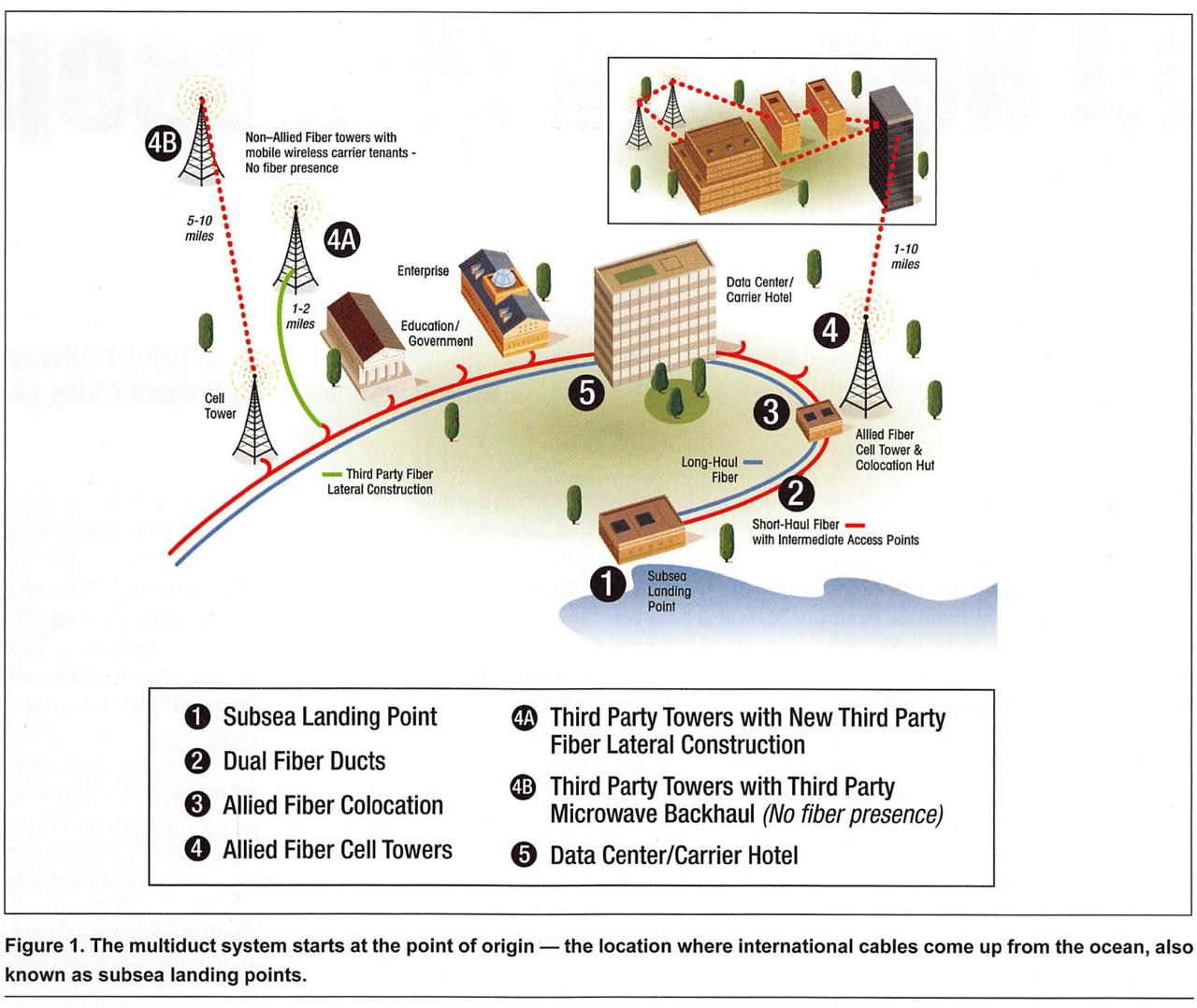
The multiduct system begins at what is called the point of origin — the location where international cables come up from the ocean, also known as subsea landing points. Although few in number, subsea landing points represent the aggregated amount of global fiber-optic cable capacity flowing around the world. The multiduct system begins and ends at these locations, harnessing the power of the networking demand of the Earth's continents and the countries, people and machines within them. In a network sense, the United States is geographically located on planet Earth right in the middle of Asia, Europe and Latin America. The major subsea networks of the world travel across the Atlantic Ocean from Europe to New Jersey and Long Island, N.Y., from South America through the Caribbean Sea to Florida and from Asia across the Pacific Ocean to Washington, Oregon and California.
With dual fiber ducts, the multiduct system runs two dark-fiber cables, one for local access and one for long-haul speed. The primary duct is for long-haul fiber. This duct contains a composite cable with a non-zero dispersion-shifted (NZDS) and single-mode fiber (SMF) type of mix to accommodate different collocation facilities along the route. In turn, the long-haul optics will be faster and more reliable when lit, with fewer splices, and will have access to other service providers in carrier-neutral collocation hubs. Additionally, the multiduct system's long-haul fiber is all dark and available for long-term indefeasible right of use (IRU) and lease, with a high-fiber count (minimum 432) throughout the system.
The second duct is for transport network requirements. The fiber cable in this duct is not meant to be spliced; this fiber is for the pre-engineered splice points and for the short-haul fiber. This duct contains a composite cable of NZDS fiber and SMF and can be spliced wherever required along the route. Fiber splice enclosures for lateral fiber cables and splices can be installed along the route at intersections with wireless towers, rural local exchange carriers (RLECs), multiple system operators (MSOs) and other networks. The short-haul duct contains a minimum 144-count cable, and is available for long-term IRU or lease.
Power and people
The multiduct system of collocation brings connectivity not only to power but also to people. Collocation facilities serve multiple purposes. They are essentially regeneration points necessary for long-haul fiber networks as well as a common, carrier-neutral, meet-me interconnection point for all network operators. They are carrier-class, monitored, secure and environmentally controlled. They have AC power and DC generator-backed power. These facilities are spaced every 60 miles along the multiduct system route and are open to the long-haul networks in the system as well as other networks including wireless carriers, wireless backhaul providers, RLECs and MSOs. Network operators do not need to lease fibers to lease rack space. Once their presence is established in the collocation facility, network operators can interconnect to any other network. Additional collocation facilities can be added anywhere along the route where there is demand for neutral interconnection.
Allied Fiber has access to the Norfolk Southern Railway microwave tower infrastructure already in place along the multiduct system route. Providing fiber to the tower (FTTT) for these towers along the route is simple and incremental both in timing and costs. These towers can be fiber-fed and then become more attractive to the wireless carriers directly. Additionally, microwave transport providers can utilize them as aggregation points for the wireless backhaul links to the wireless carriers sitting on towers within 10 to 20 miles that presently have no fiber for backhaul. These towers will be fiber-fed from the multiduct system's short-haul duct. Those fibers connect back to the collocation facilities and intersect with the long-haul fibers. At that point, the transport providers can either lease their own dark fiber and light it for transport to the major carrier hotels, data centers and interconnection points or just lease lit capacity from the long-haul carriers already coming through the site.
Tower availability
Thousands of wireless towers already are in operation within a few miles of the multiduct system route. They are owned and leased by the various tower operators. The vast majority of these towers have no fiber facilities, and even those that do most likely have no carrier-neutral dark fiber for lease to any and all transport providers. The multiduct system, including the short-haul duct for FTTT, provides for lateral fiber to be constructed to these towers. That fiber can then be spliced to the short-haul fiber and brought back to the collocation facilities. Once there, Ethernet transport carriers can establish their switches to serve multiple towers and wireless carriers from a single collocation site. From that point, the wireless carrier data can be backhauled to the transport providers' switching sites much more efficiently and cost effectively.
For towers beyond a few miles from the multiduct system route, perhaps too far to justify construction of fiber laterals, microwave transport can be used for wireless backhaul. Many wireless carriers already use microwave wireless for backhaul. The Norfolk Southern Railway towers and any tower fiber-fed from the multiduct system route enable microwave transport for wireless backhaul aggregation points. From these towers, microwave transport providers can serve towers beyond the practical economic reach of fiber to deliver the Ethernet circuits that wireless carriers need to operate their 3G/4G networks.
During the past 10 years or more, carrier hotels and data centers in the United States and elsewhere have developed and matured. They have become critical to the operation of many network types. The greatest numbers of metro, regional and long-haul transport networks reside within the major carrier hotels. These sites enable direct access to these networks and choice among providers. That choice allows for buyers to attain better contract terms, pricing and quality. The multiduct system routes dark fiber among these existing locations to provide direct connections for the long-haul networks to enable diverse routing paths between these endpoints. In addition, the multiduct system allows those long-haul networks to deliver sub-rate circuits out of collocation facilities along the route for rural broadband, wireless backhaul and other network needs, thus creating the maximum value potential for any long-haul route.
Hunter Newby was chief executive officer of Allied Fiber at the time of this writing.
About the Author

Hunter Newby
Founder, Newby Ventures
Entrepreneur, investor, and interconnection pioneer. Co-founded Telx, conceived the carrier-neutral Meet-Me-Room, and led data center development across the U.S. Now investing in network-neutral infrastructure through Newby Ventures.
Read more about Hunter →